A Cat Engraving … a Cat?
-
Author
- Clare
-
Published Date
- December 19, 2025
Kaiden Underwood, a third year History student at the University of Reading, explores a new acquisition by Agnes Miller Parker.
Who was Agnes Miller Parker?
The painter and printmaker Agnes Miller Parker (1895-1980) was born in the Scottish town of Irvine. She attended Glasgow School of Art where, in 1917, she won the Haldane Travelling scholarship. A year later, in 1918, she married fellow painter William McCance (1894-1970). The pair moved to London where Miller Parker taught in Gerrards Cross and Clapham, while McCance was, among many things, an art critic for The Spectator. They also became friends with the wood engraver, Blair Hughes-Stanton (1902–1981), and his wife Gertrude Hermes (1901-1983), who encouraged Miller Parker to refine her self-taught skills to pursue wood engraving.
In 1930, both couples moved to Newtown in Wales to work for The Gregynog Press. The Press specialised in rare books, with the design, typography, illustration, printing and binding all done in Gregynog Hall. Two books illustrated by Miller Parker, The Fables of Esope (1932) and XXI Welsh Gypsy Folk-Tales (1933), are considered some of the finest examples of wood engraving of their period.
In 1944, the couple moved to Reading, where McCance became a lecturer in Typography and Book Production at the University. Five years later, they joined the Reading Guild of Artists and in 1955 exhibited together for the last time. They separated in the same year with their divorce finalised in 1963. Miller Parker never remarried. She moved to the Isle of Arran where she continued to work until her death.
A New Acquisition for the University of Reading Art Collection
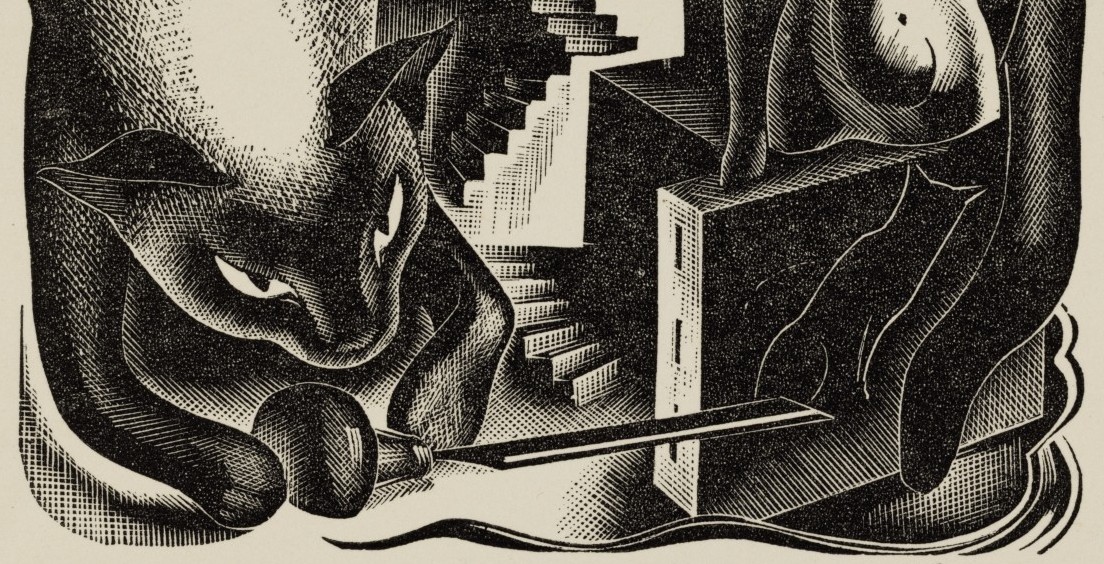
In November 2025, Martin Andrews (print historian and retired Lecturer in Typography) donated this artwork by Agnes Miller Parker to the University of Reading Art Collection. The wood engraving features a cat holding a tool called a “spitsticker”. It is using this tool to engrave another cat onto a piece of wood. The cat’s body surrounds an assortment of different items – a nude, two perched birds and a building with a strange arrangement of stairs leading up to it.
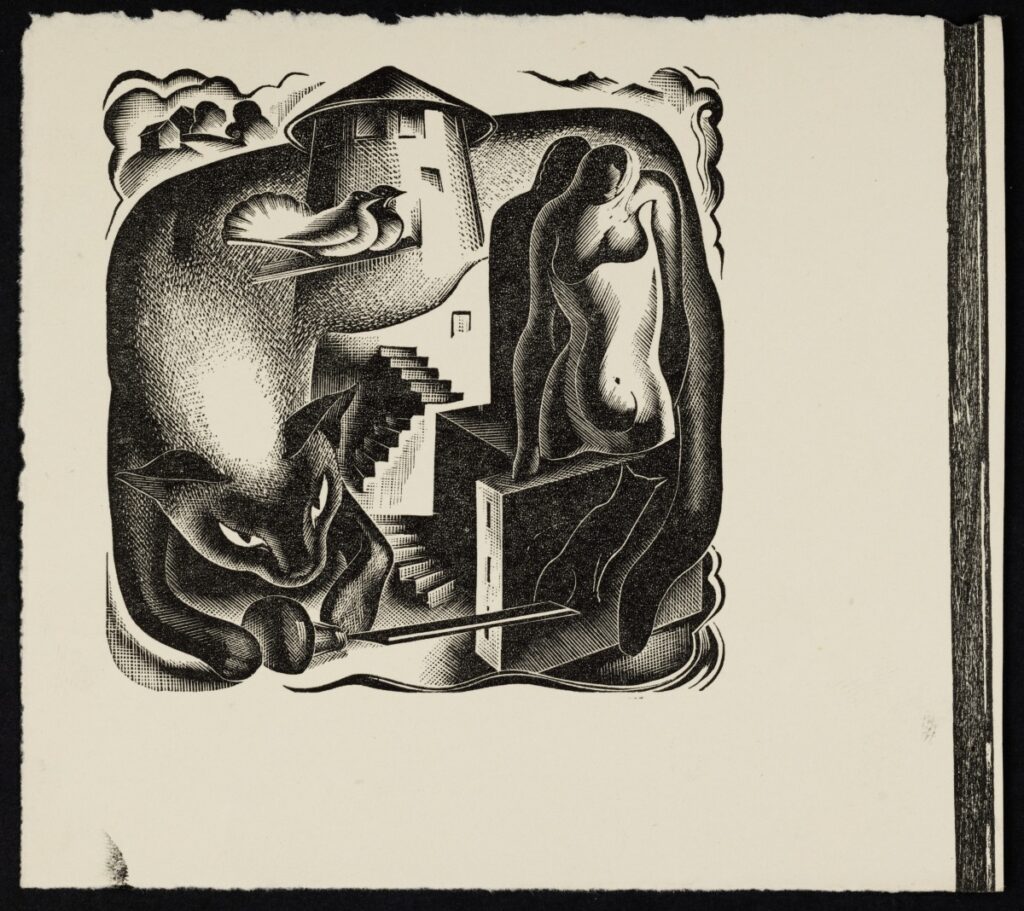
The first thing I noticed about this artwork was the cat engraving another cat onto a block of wood. I found this rather charming and, I think rather naturally, it brought a smile to my face. Looking at the rest of the piece, I felt it becoming slightly more confusing with a seemingly random collection of objects surrounded by the cat.
Agnes Miller Parker frequently used cats in her art. One reason for this was, quite simply, that she liked cats. Miller Parker had pet cats which she used as inspiration in her drawings and engravings. In particular, she liked Siamese cats and created artwork of them in both colour and in black and white.
Another artwork by Agnes Miller Parker that depicts a feline is The Uncivilized Cat (1930). It is thought that the cat may represent Miller Parker, as an outspoken feminist, surrounded by objects symbolising women’s rights. We can link this reading of The Uncivilized Cat with the new acquisition. Could it be the large cat is Agnes Miller Parker creating a new artwork? While the rest of the objects in the piece aren’t easily explainable, Miller Parker’s connection with cats, seen throughout her oeuvre, could indicate this is a self-portrait. I believe this further enhances the initial charming reaction to the piece.
The Skill of Wood Engraving
To truly appreciate a wood engraving, I believe it is essential to understand the process.
- A block of wood is selected and painted black so the engraver can see any changes.
- An outline or rough sketch of the finished design is created on paper.
- The engraver takes sections from this drawing and traces the outline onto the wood. It is important not to include lots of detail so a new piece of art is made.
- After the initial tracing is done, it is reinforced with another layer of pencil.
- The work is now ready for engraving.
Engraving requires many different tools: the most traditional is the lozenge graver which creates straight lines. Another frequently used tool is the spitsticker: this is the same tool the cat is using in Miller Parker’s artwork. The spitsticker tool creates curvy lines while engraving.
After the engraving is complete, an oil-based relief ink is rolled over the work until it is smooth. A key tip: if the engraving has enough ink it will sparkle in the light! At this stage the engraving is put into a press with a piece of paper. They are squeezed together to transfer the ink.
What is clear to me is the amount of effort and skill it takes to create a wood engraving. This helps me to really appreciate this wood engraving by Agnes Miller Parker, a well thought out, charming piece of art that would have taken many hours to complete.
Bibliography
‘Agnes Miller Parker: Two Siamese Cats’, National Galleries of Scotland [website] (updated 2020), https://www.nationalgalleries.org/art-and-artists/16440 (last accessed 11 December 2025).
Bishop, H., Oxford Dictionary of National Biography [website] (23 September 2004), https://www.oxforddnb.com/display/10.1093/ref:odnb/9780198614128.001.0001/odnb-9780198614128-e-64830?rskey=7ZvNgY&result=1 (last accessed 11 December 2025).
Elliot, P., ‘Artist of the Machine Age’, The Herald (27 May 1995), https://www.heraldscotland.com/news/12104811.artist-of-the-machine-age/ (last accessed 8 December 2025).
Gregynog [website], https://gregynog.org/about/gregynog-press/ (last accessed 9/12/2025).
MacDiarmid, H., ‘Agnes Miller Parker: Artist in Focus’, The Fine Art Society [website], https://www.thefineartsociety.com/journal/issue-1/agnes-miller-parker/ (last accessed 8 December 2025).
Macpherson, A., ‘How to… make a wood engraving, with Anne Desmet’, Royal Academy of Arts [website], (Published 5 October 2026), https://www.royalacademy.org.uk/article/how-to-make-wood-engraving (last accessed 9 December 2025).
National Galleries of Scotland [website], https://www.nationalgalleries.org/art-and-artists/artists/agnes-miller-parker (last accessed 8 December 2025).
Agnes Miller Parker’, Reading Guild of Artists [website], (November 2022), https://rga-artists.org.uk/museum-highlight/agnes-miller-parker/ (last accessed 9 December 2025).
The British Museum [Website] https://www.britishmuseum.org/collection/term/BIOG41131 (last accessed 8 December 2025).