Valentine’s Day Cards – The John Lewis Printing Collection
-
Author
- micheledrisse
-
Published Date
- February 14, 2016
Written by Louise Cowan, Trainee Liaison Librarian
February 14th celebrates Valentine’s Day, the Christian feast day of the martyred St Valentine of Rome. While we know that the celebration originated around 498 A.D when it was instated by Pope Gelasius, little is actually known of St Valentine and his life. The most popular version recounts the story of Valentinus, a priest who was imprisoned and sentenced to death by Emperor Claudius. While in jail “he befriended his jailer’s daughter and on 14 February 270, wrote her letter signed ‘From your Valentine’,” (Lewis, 1976). The day’s ties to love and romance however, go back much further, to the pagan fertility festival, Lupercalia, which was celebrated across 13-15thFebruary.
Despite its long history, the first written Valentine greeting is often attributed to Charles, Duke of Orleans who wrote romantic notes to his wife while imprisoned in the Tower of London in 1415, (Novareinna). The seventeenth century saw Valentine’s Day become ‘the most festive day of the year,’ (Lewis, 1976), and it was popular enough to be mentioned by Shakespeare in Ophelia’s lament in Hamlet – (Act 4, Scene 5) (Telegraph, 2010).
To-morrow is Saint Valentine’s day, /All in the morning betime,/And I a maid at your window,/To be your Valentine.
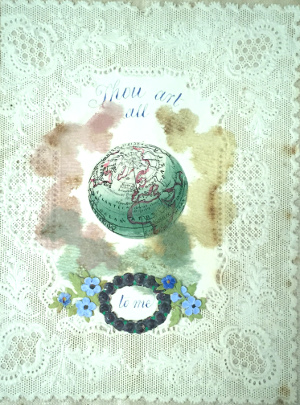
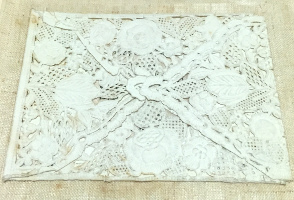
However, Valentine’s Day cards did not come into fashion until the end of the eighteenth century and though early cards were often hand-made, the trend developed quickly so that by the beginning of the 19th century, cards had become ‘highly complicated pieces of print and assembly with lace-like embossing.’ (Lewis, 1976)
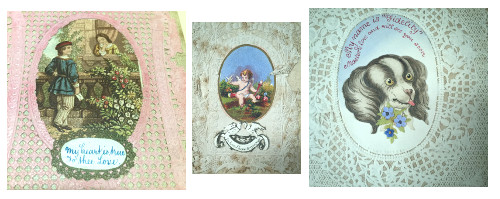
The embossing and lace-effect seen in the cards above from our John Lewis Printing Collection was achieved ‘by placing the paper on an engraved die and pressing it,’ (Lewis, 1976). There were however, numerous styles of Victorian Valentine’s cards in production, including: acrostic verses spelling out the loved one’s first name; puzzle purses, a folded puzzle containing verses to be read in a certain order; love knots and rebus riddles, Valentine’s which substituted words for pictures, (Novareinna). This rebus from our John Lewis printing collection is quite simple but effective:
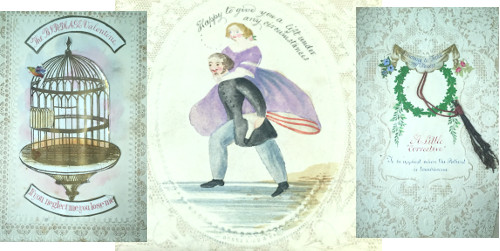
A number of the cards in our John Lewis printing collection are also quite humorous (and a little bit cheeky!) particularly the card on the right (below) which offers ‘Something to tickle my fancy – a little corrective to be applied when the patient is troublesome’!
As well as cards, the collection also features a small number of love notes, including this letter with a charming little poem:
‘’In vain I’ve racked my brains,
In vain I’ve taken endless pains,
For not a single thought will come,
Except, “I love you”, little one!
I love your shy and gentle air,
I love your curls of golden hair,
I love your little winning wiles,
Your merry laugh, your beaming smiles,
Your bonny brow, your eyes so blue,
Your parted lips of rosy hue
I love your cheeks, your chin, your nose
I almost think I love your toes!
I love you all dear Georgie mine,
I am your faithful Valentine.”
As with postcards the introduction of the penny stamp boosted Valentine’s card sales in 1840 and the tradition of sending anonymous greetings came into fashion. However, the rise in popularity of Christmas cards in the nineteenth century eventually saw to a decline in Valentine’s (Lewis, 1976). Today, Valentine’s Day remains the second most card-heavy celebration with an estimated 1 billion cards being sent worldwide in 2010. (Telegraph, 2010)
Sources:
Lewis, J (1976) Collecting Printed Ephemera. London: Cassell and Collier Macmillan