Memoir on the Dodo
-
Author
- micheledrisse
-
Published Date
- April 14, 2016
Written by Louise Cowan, Trainee Liaison Librarian
One of the interesting finds from our cataloguing and reclassification of the Cole Library Collection is ‘Memoir on the Dodo’ by Sir Richard Owen, an eminent English biologist and palaeontologist.
The initial discovery of Dodo remains in the mid nineteenth century led to some controversy in the scientific community. Owen, who was somewhat notorious for his ruthless behaviour, is said to have intercepted material intended for another researcher, Alfred Newton. Owen then argued that, “possession of the best material was a prerequisite for publication priority, which provided him with a complete monopoly,” (Hume, Cheke & McOran-Campbell, 2009). With the success of his application as a Professor in danger of being side-tracked by Owen, Newton was unable to complain and was forced not only to, “relinquish access to the best Dodo bones promised to him, but he also had to withdraw the Dodo manuscript that had already been submitted,” (Hume, Cheke & McOran-Campbell, 2009).
Despite the circumstances surrounding its author, Owen’s work remains a significant contribution to the Zoological sciences.

The book consists of a historical introduction by naturalist William John Broderip; an explanation from Owen on how he came to be in possession of the collection of bones discovered on Mauritius by George Clark in 1865, and finally a description of these bones alongside several illustrative lithographic plates. According to Hume, Cheke & McOran-Campbell (2009), the book had a limited run of only 100 copies with 20 intended for presentation to Owen’s supporters. Our volume is dedicated by the author to the Bishop of Mauritius; the friendship between the two having played a key role in Owen’s receipt of the Dodo remains.
Broderip’s introductory history focuses on both written and pictorial evidence for the existence of the Dodo. He examines first-hand accounts from travellers to Mauritius from as early as 1598, quoting their descriptions of the bird. The following is from Jacob van Neck and Wybrand van Warwijk’s voyage in 1598:
As large as our swans, with large heads, and a kind of hood thereon; no wings, but, in place of them, three or four black little pens (penekens), and their tails consisting of four of five curled plumelets (Pluymkens) of a greyish colour.

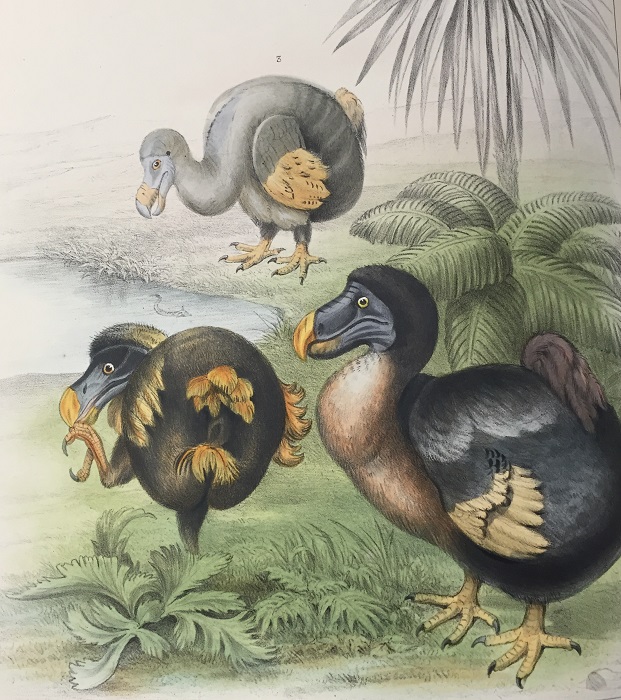
Broderip also makes mention of the Dodo remains held in Oxford and the remains of a leg that had been held by the British Museum. Following Broderip’s death, Owen took up the narrative, describing other museum artefacts as well as art works featuring the Dodo. All three Dodos depicted in this beautifully coloured plate (below), taken from the front of the book, are from paintings by Roelandt Savery, a Flemish-born Dutch Painter. Owen combined the figures to create an ‘Ideal scene in the island of Mauritius before its discovery in 1598.’

However, Owen’s belief that Savery’s paintings were drawn from a living bird, caused him to make a serious mistake in his reconstruction of the creature. Owen recreated the bird’s image by fitting the skeleton into an outline traced around Savery’s Dodo image but, “this produced an unnatural, squat and overly obese Dodo,” (Hume, Cheke & McOran-Campbell, 2009). While Owen rectified his error in a later publication, the original image stuck and remains a common misconception.

Sources:
Owen, R. (1866) Memoir of the Dodo. London: Taylor and Francis [COLE 196F/103 – available on request]
- A scan of ‘Memoir of the Dodo’ is available here.
- P. Hume, A.S. Cheke & A. McOran-Campbell (2009) How Owen ‘stole’ the Dodo: academic rivalry and disputed rights to a newly-discovered subfossil deposit in nineteenth century Mauritius, Historical Biology, 21:1-2, 33-49
-
Published Date
- March 9, 2026
Visualising class, disability, and race on the Victorian stage
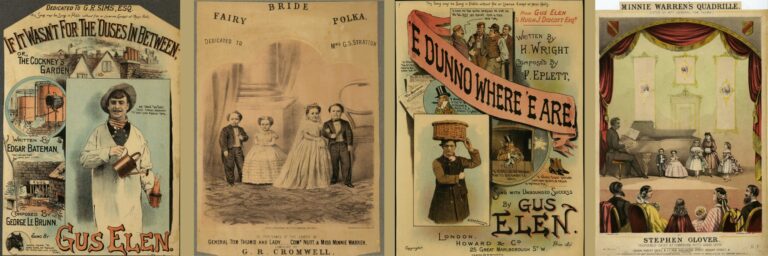
This post introduces, via sheet music covers, a few more real individuals whose stories can be used to explore histories of marginalised people. With only 800 of the covers catalogued so far, there are sure to be countless stories still waiting to be rediscovered.