The immortal legacy of James Joyce
A review of the University of Reading Special Collection’s exhibition James Joyce: Enigmas and Puzzles, which ran from October 2025 to February 2026, by Jared Geraghty, undergraduate in Art.
-
Author
- Jackie
-
Published Date
- April 27, 2026
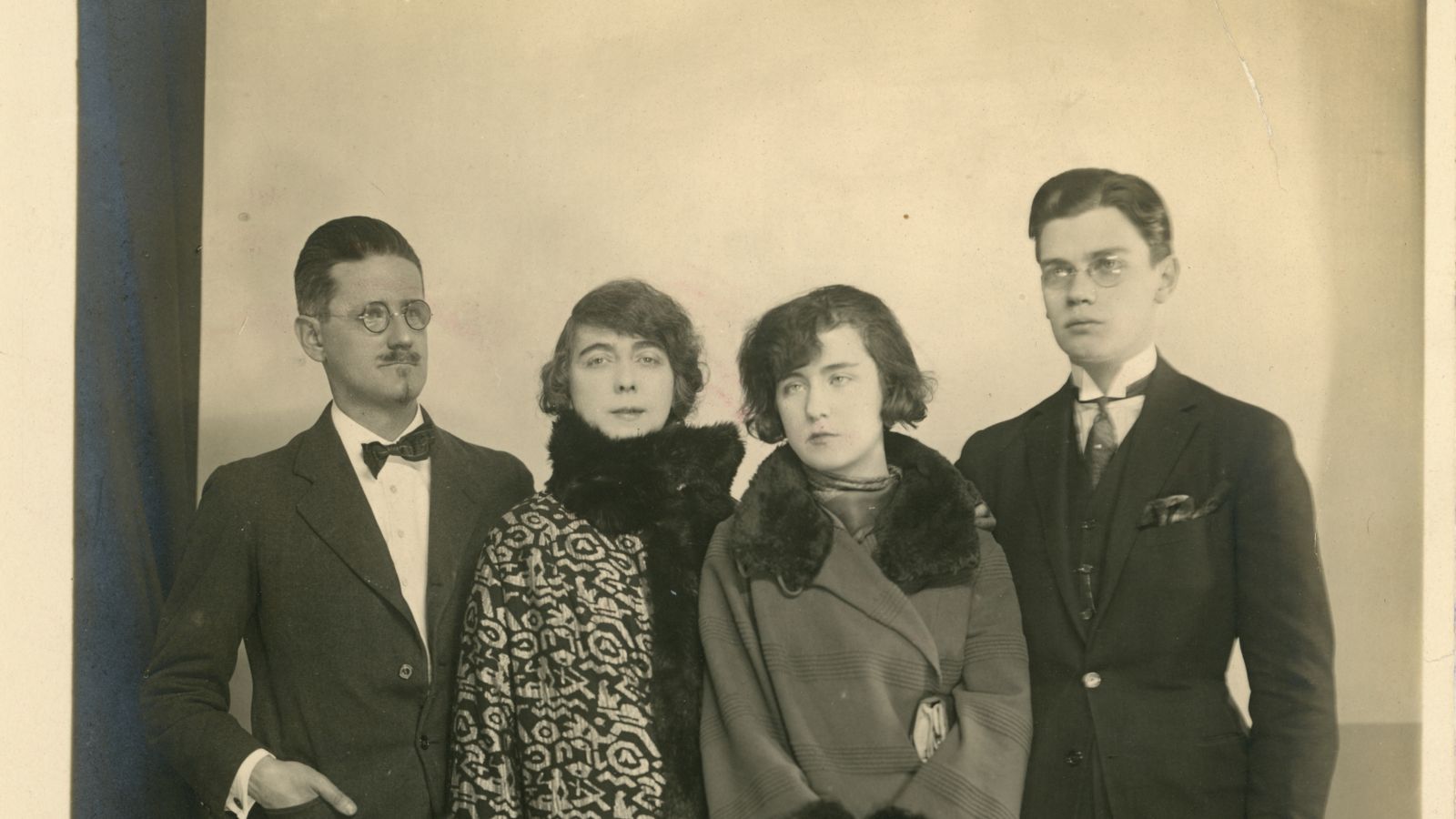
L-R: James, Nora, Lucia and Giorgio Joyce.
“I’ve put in so many enigmas and puzzles that it will keep the professors busy for centuries arguing over what I meant, and that’s the only way of insuring one’s immortality.” – James Joyce
James Joyce: Enigmas and Puzzles, the latest exhibition at The University of Reading’s Staircase Hall display space, provides proof of Joyce’s immortal legacy. Known as one of the most influential writers of the twentieth century, James Joyce is highly regarded for his stream-of-consciousness style, particularly in his novel Ulysses (1922), which made him one of the pioneers of Modernist literature. This exhibition offers a deeply intimate and humanising insight into the life of one of history’s greatest writers.
The exhibition highlights the personal archive of Joyce’s own grandson, Stephen James Joyce, who chose to donate to the University of Reading due to their esteemed Samuel Beckett collection. Both Irish writers with a mutual love of romantic languages, Joyce and Beckett fostered a close friendship during their lifetimes, starting in the late 1920s whilst Joyce was working on his final novel, Finnegans Wake (1939). Beckett first saw Joyce as a mentor, inspiring his own budding writing practice, but he soon became a close friend to the family. It is fitting, then, that their works now reside together in the University of Reading’s Special Collections.
What immediately struck me about this exhibit is the way it captures Joyce with so much depth. Laid out in a relatively small room, it is clear that every item displayed has been carefully considered and curated with the intention of capturing the person behind the literary icon. Despite its modest size, Joyce’s character shines through in every aspect of the show.
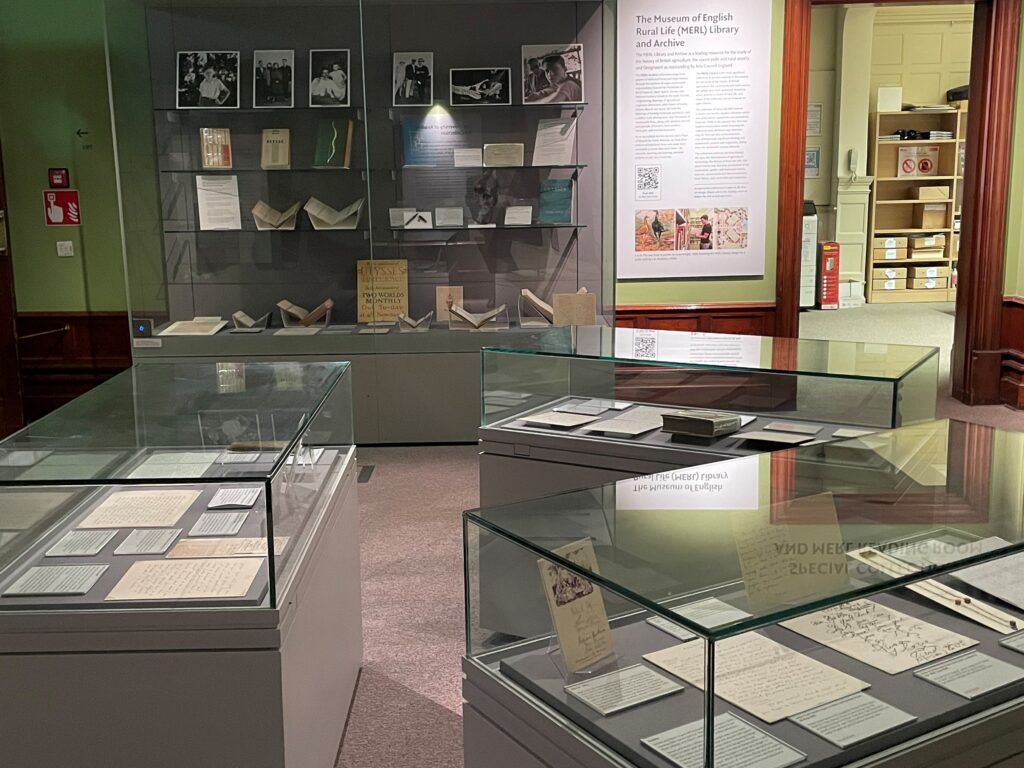
The exhibition featuring James Joyce’s personal archive and library.
The most touching elements are the many tributes to his wife, Nora. These include a handwritten manuscript of Chamber Music, a collection of lyrical love poems dedicated to her; a necklace Joyce commissioned for their anniversary, featuring five ivory cubes for each year of their relationship and an inscription of his own poetry: “Love is unhappy when love is away”; as well as a letter that cheekily opens, “My darling, my love, my queen…” in which he apologises after a fight that resulted in Nora taking the children back to Ireland. These snippets of their marriage capture a side to Joyce one might not expect; they are warm, playful, and heartfelt.
Also displayed are many doting letters written to his children, often in green ink which made it easier for him to write as his eyesight deteriorated. Joyce’s battle with his vision is painfully documented in the many letters to and from his doctors, the endless prescriptions, news clippings, as well as his own glasses case. There is something especially awe-inspiring about seeing his determination to write despite his ailment. His formidable passion for his craft bleeds through just as much as his adoration of his family does. Nothing encapsulates this better than one of my favourite pieces displayed: a Parker fountain pen with a gold charm of Joyce’s novel Finnegans Wake inscribed with the words, “To Babbo,” gifted to him by his son, daughter-in-law, and grandson.

One of the more unexpected aspects of the exhibition is its section dedicated to Harriet Shaw Weaver, Joyce’s friend and patron. Weaver was a fierce advocate for artistic freedom, and, with her help, Joyce was able to publish Ulysses despite its initial ban for obscenity. I found it incredibly enlightening to see her influence over Joyce’s career as she offered notes on research and potential ideas for his novels in their letters. It is surreal to imagine that without Weaver’s friendship and belief in his craft, Joyce may not have been able to publish his most celebrated works.
Overseeing the show are several portraits of Joyce. Perhaps most famously is Augustus John’s portrait in red chalk, made in 1930. The masterful drawing has a life-like softness to the facial features, with the strokes becoming far freer in the hair, neck and shoulders. The charm of this piece is the aged paper, showing that it had been displayed and cherished before its donation. Percy Wyndham Lewis’s 1932 portrait feels much less posed, with its sharp lines that are buzzing with energy. In this lithograph print, Joyce is looking down, as though caught in the middle of his work. My personal favourite is Horst Jannsen’s print, made in 1966. This portrait feels the most vibrant, with Joyce’s quizzical expression and furrowed brow captured in spindly, swooping strokes of ink. Finally, there is Tullio Pericoli’s ink and watercolour portrait of Joyce, made in 2004, which has fittingly been used for the exhibition’s poster. This small drawing contains so much of the personality that is shown in every element of the exhibit. Joyce is depicted squinting into a magnifying glass, determined to continue reading. Only his polka-dotted bowtie is coloured, yet this only amplifies the charm of the piece.
The triumph of this exhibition is its ability to present Joyce in such a personal and human way. It offers an engaging and informative insight into both Joyce’s magnificent career, as well as the relationships he nurtured with those around him. Beyond being one of the most celebrated authors of the twentieth century, he was a doting husband, a kind father, and a loyal friend. I walked away realising that what makes Joyce immortal is not just his literary influence, but his relationship with those he loved most.
The exhibition was open from October 2025 to February 2026.
-
Published Date
- March 9, 2026
Visualising class, disability, and race on the Victorian stage
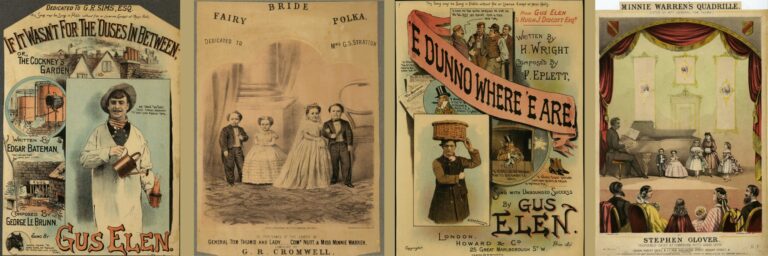
This post introduces, via sheet music covers, a few more real individuals whose stories can be used to explore histories of marginalised people. With only 800 of the covers catalogued so far, there are sure to be countless stories still waiting to be rediscovered.