Wilfred Owen, Mabel Rayner, and a solar eclipse
In our new blog, Dr Rhi Smith reveals the story of Wilfred Owen and Mabel Rayner's chance meeting during a solar eclipse and the impact of each on the life of the other.
-
Author
- Danni
-
Published Date
- August 12, 2026
‘I shall be better off with plants that share
More peaceably the meadow and the shower’
Wilfrid Owen, ‘A Terre’
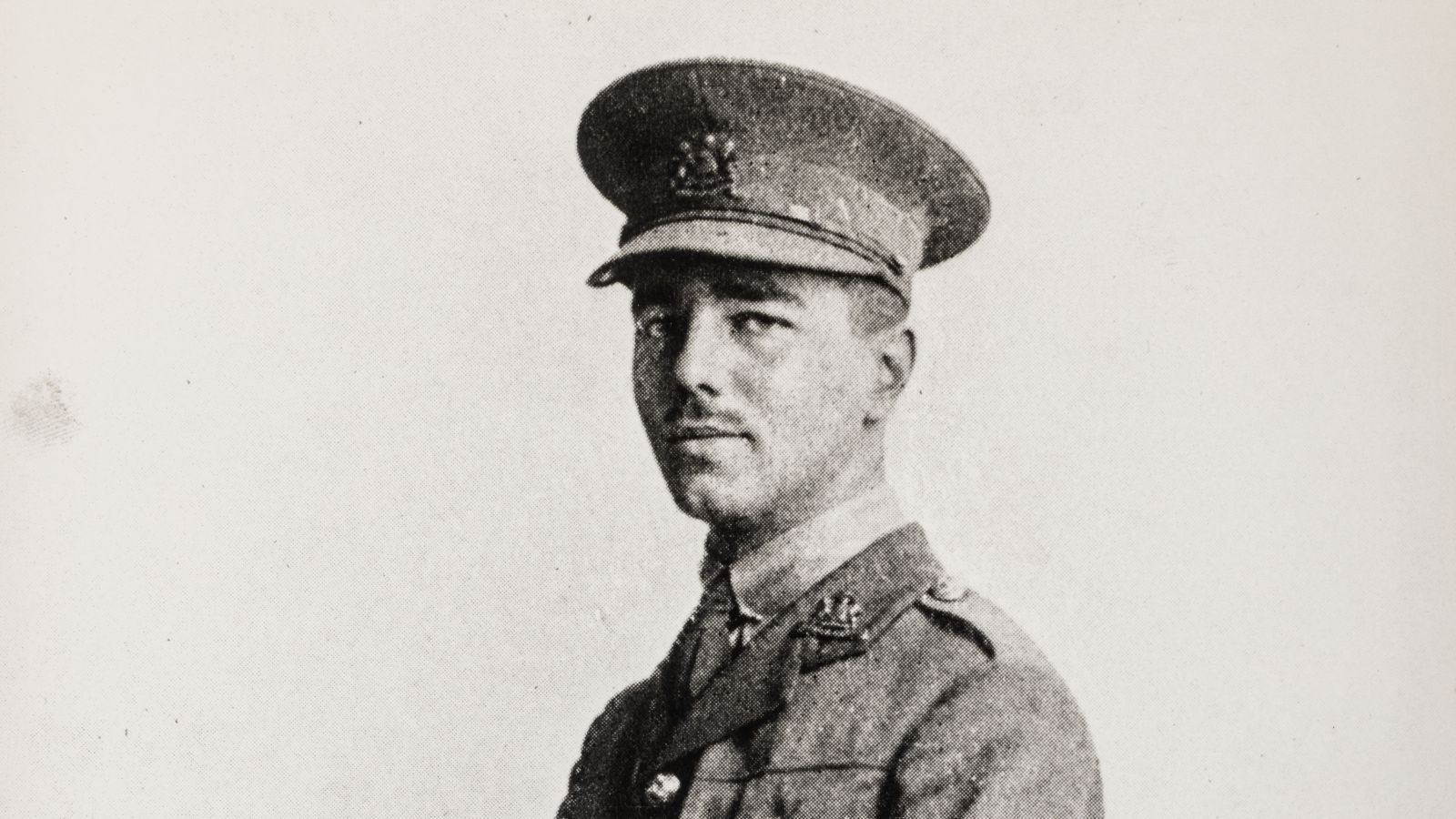
On April 17, 1912, a 19-year-old vicar’s assistant cycled to Reading from his lodgings in Dunsden, near Sonning. He was seeking further education at University College Reading (now the University of Reading), which had recently moved to a new cloistered site on Reading’s London Road.
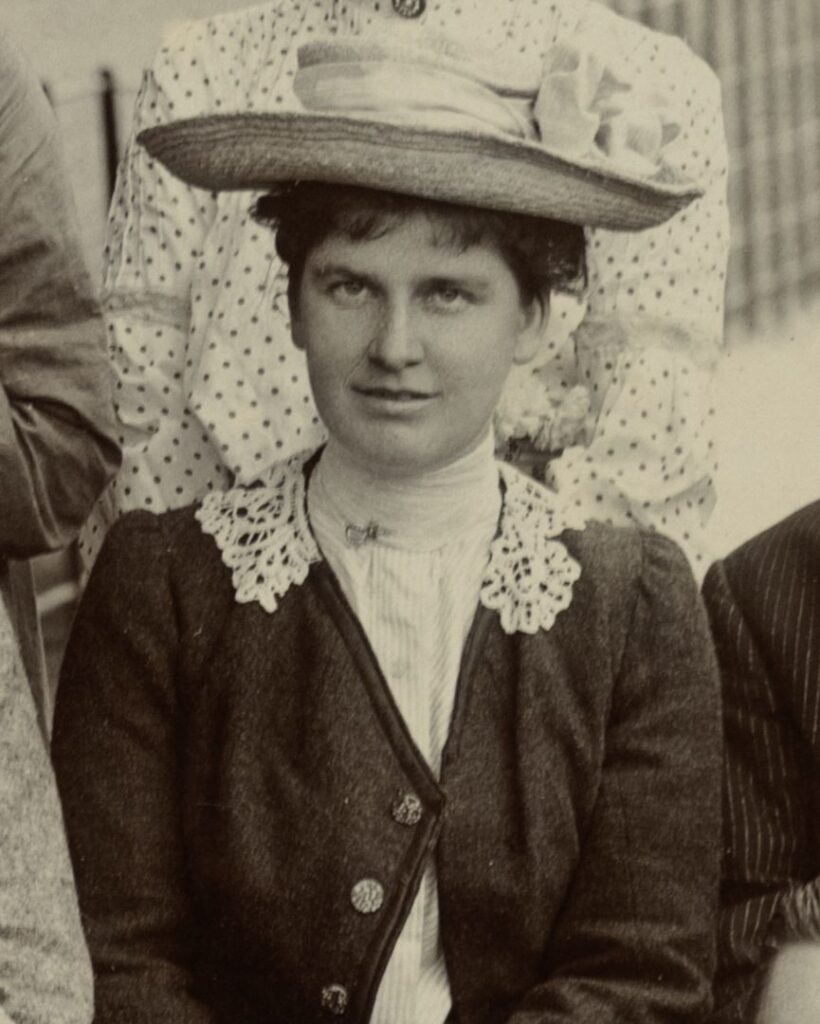
He arrived in Reading to find the world transformed by a solar eclipse. He met a 38-year-old botany lecturer, Mabel Rayner, capturing it in a photograph. When he returned home, the young man documented the phenomenon in his own way, describing in words that ‘the sky was clear, and very weird the universe seemed; the atmosphere dulled as if charged with volcanic dust, especially on the horizon’.
This blazing use of language was idiosyncratic of the young man’s work. His name was Wilfred Owen, one of the great poets of the First World War (1893 – 1918).
Students of plants and poetry
Six weeks after this meeting, Owen returned to Reading to study botany with Rayner for six hours a week.
Rayner (1874-1948) had worked at University College Reading since 1905, aged 24. She graduated from Reading in 1902 with a Certificate of Horticulture and in 1908 with a First-Class BSc from the University of London (because at that time, Reading couldn’t grant degrees). At Reading, she collaborated with her future husband William Neilson-Jones in studying Calluna (heather) on the local downs. She never received a professorship but played an important role in running the department during the First World War.
Owen and Rayner made mutually strong first impressions. Owen wrote that ‘when Miss R[ayner] heard that I had to go home to Dunsden to tea, she took me to her rooms, and gave me the privilege of a cup of tea and her private conversation. She must be over thirty; has bluntness of manner and a great force of character, (I suppose) and who knows what learning and cleverness’. Meanwhile, Rayner remembers Owen as ‘a shy and not very happy boy’, ‘lonely and rather distracted’. She took him under her wing. Not long after that first meeting, Rayner invited Owen to a country excursion to admire plants. He did not get on well with most of the other students, describing the women as ‘nothing much to look at: and nothing more to talk to’.
Owen and Rayner connected through a shared love of nature and poetry. On 20 July, Owen spent an evening with Rayner and her future husband reading poetry:
‘Last night I got home at 12.20 am after an evening’s dissipation with Miss Rayner and Mr Jones. She read Swinburne to us. I read – [Keats] need I say. I did some good work for Bacon, (as Shakespeare). Fine, if I can infect the College, eh? Miss R is very friendly w. Ruskin’s Priv. Sec. And Biographer [WG Collingwood who had just stepped down as Head of Art], and is going to mention my sojourn to the Lakes to him. I must go & see him!’
Later that year, Rayner introduced Owen to Edith Morley – Professor of English Language at Reading from 1908 to 1940. Morley convinced Owen to apply for a scholarship. Ultimately, Owen did not get the grades and instead took on a job teaching in France.
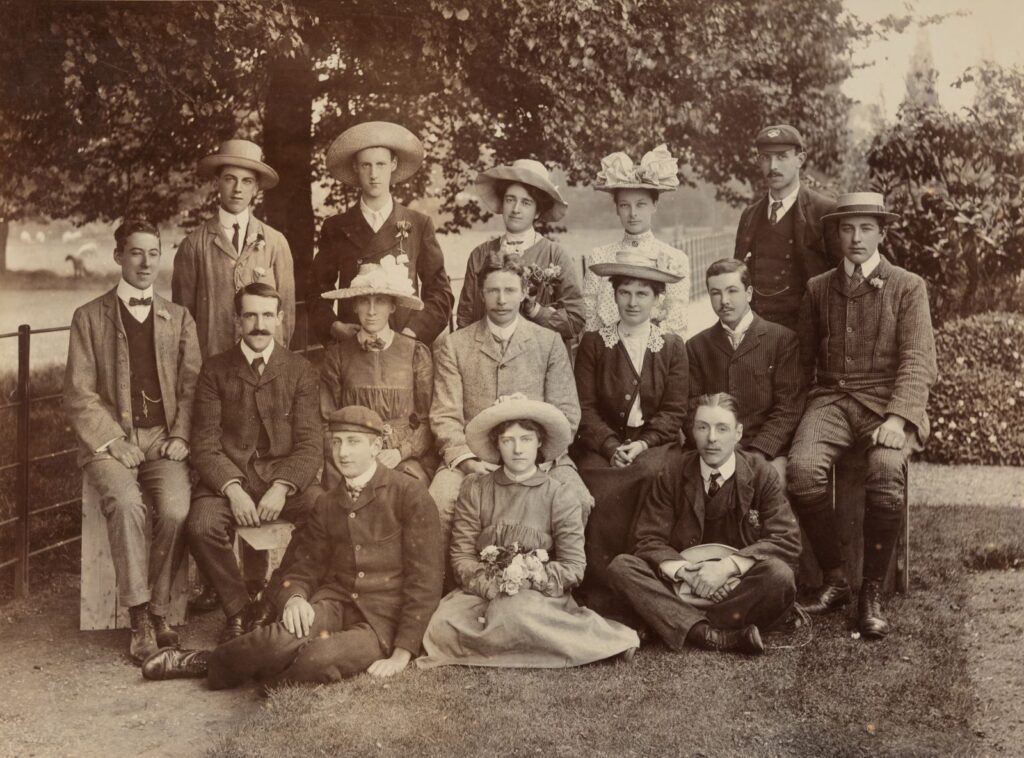
Back row (L to R): B G H Maclear, H G Langton, Miss Seaton, Miss Hart Davis, B P Murrell,
Middle row (L to R): A G Mackay, F G Storrs, Miss Miller, F W Keeble (Director), Miss Rayner, J D Hay, G N Smale,
Front Row (L to R): Richardson, Miss Wallace, J F N Bartlett
(UHC PH3/2/32)
Owen in France
Although Owen was in France at the outbreak of the First World War, in July 1914, he didn’t immediately enlist. In October 1915, he wrote a letter on the heather at Merignac, remembering family holidays and Dr Rayner. Rayner tried to convince Owen to become a munitions worker – like her husband – but Owen joined the Artists Rifles. He served as a second lieutenant with the Manchester Regiment and continued his writing. Both Rayner and Morley read and commented on Owen’s early prose, which Morley found too poetic.
While serving in France, Owen was hit by a blast and spent several days unconscious amongst the bodies of his fallen comrades. Shortly afterwards, he developed ‘shell shock’ – today, post-traumatic stress disorder – and was sent to Craiglockhart Hospital in Edinburgh in June 1917. It was there that his poetry developed through a friendship with fellow poet Siegfried Sassoon (1886 – 1967).
By the summer of 1918, Owen had secured a publisher for his poems, but he was also deemed fit to return to duty. Before he returned to the front, he visited Rayner for what they both knew was probably the final time. This would have been around August 1918, as Owen returned from Scotland towards to the front line in France. Rayner recalled this meeting in a later letter to a peer:
‘[Owen] spoke with great appreciation of the time he had spent in France before the War and of how his feet had been set upon the right path towards a literary goal for himself. We kept away from the war but I remember the visit chiefly because of what was left unsaid and the impression left with me of an agonising struggle before he had been able to accept the inevitable.
I never saw him again, and I have been conscious ever since of the feeling very acutely felt at the time that he had asked for bread and I had given him a stone, for our friendship had been too intermittent to allow anything like full expression of what one was really feeling about the world we were living in. Many of us, you know, at that time, were feeling rather numb, and were, if anything, glad of the escape to over-work and the over-fatigue that followed’.
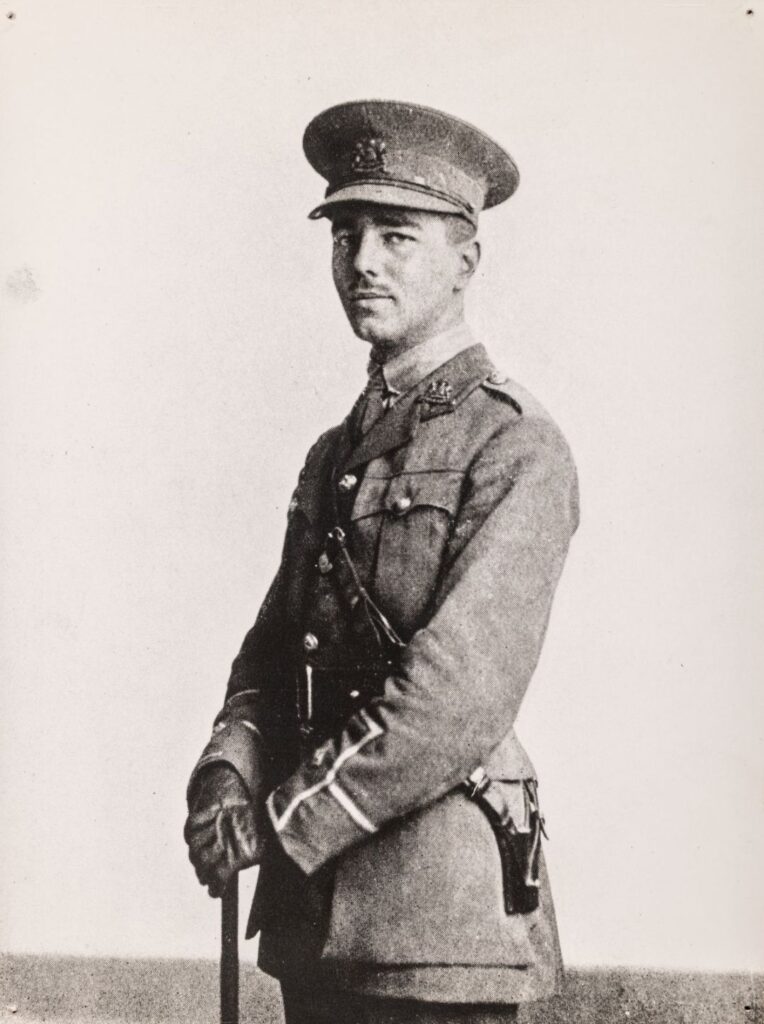
Remembering Owen and Rayner
Owen died just a few months later, on 4 November 1918, one week before Armistice. He was aged just 25.
Rayner left the University of Reading shortly after and became a researcher for the Forestry Commission. She became an internationally renowned expert on mycorrhiza, the symbiotic relationship between fungi and the roots of trees. She travelled around the British Empire seeking samples and shared a laboratory with her husband. Working at the Forestry Commission’s test site in Wareham, her research allowed her to reintroduce trees to heathland. Her scientific publications include Mycorrhiza (1927), ‘Problems of Tree Nutrition’ (1944), and ‘Trees and Toadstools’ (1945). She died in 1948.
Rayner noted that while she and Owen were never close, she remembered him fondly. Owen left no will but did leave a list of 20 names of recipients for his first book of poems, including Rayner. When his possessions were returned from France, he was carrying a copy of Swinburne’s poems, the poet Rayner introduced him to back in 1912. Inside it is inscribed with his name and the date August 1918, suggesting some connection to his last meeting with Rayner. Owen had written to his cousin in October noting he was reading Swinburne and a friend remembers him reading it in the days before he died. When researcher Guy Cuthbertson took the book out of its wrapping, it still smelled of cigarettes and he found a stanza of one poem heavily underlined.
‘The burden of dead faces. Out of sight
And out of love, beyond the reaches of hands.
Changed in the changing of dark and light,
They walk and weep about the barren lands
Where is no seed nor any garner stands’
Written by Dr Rhi Smith. This story was uncovered through the University History Collection (UHC) and connects with the ongoing Centenary project. It began with a name found in the UHC library records, followed by further research online and in print with Sharon Maxwell generously searching the UHC archives to bring Mabel Rayner’s story to light. The photographs of Owen and Rayner are also held in the University History Collection.
With thanks to Sharon Maxwell, Emma Farmer, and Samantha Baxter for their help.
References
Manchester, University of Manchester Library, MS DSW 1/1/1/25/8, ‘University College Reading’, M.C. Rayner to Dennis Welland, 25 September 1947, f. 3r.
Cuthbertson, G. 2014. Wilfrid Owen. Yale University Press.
Fox, B. 2000 Wilfrid Owen 1893-1918: The Thames Valley Connection. Berkshire Old and New. No. 17, pp. 27-34
Owen and Bell 1975 Wilfrid Owen: Selected Letters. Oxford University Press.
Swinburne, A.C. 1866 ‘A Ballad of Burdens’. Poems and Ballads. Edward Moxon & Co.
Latest News and Views
-
Published Date
- March 9, 2026
Visualising class, disability, and race on the Victorian stage
This post introduces, via sheet music covers, a few more real individuals whose stories can be used to explore histories of marginalised people. With only 800 of the covers catalogued so far, there are sure to be countless stories still waiting to be rediscovered.