Fragments of medieval manuscripts
-
Author
- micheledrisse
-
Published Date
- October 25, 2016
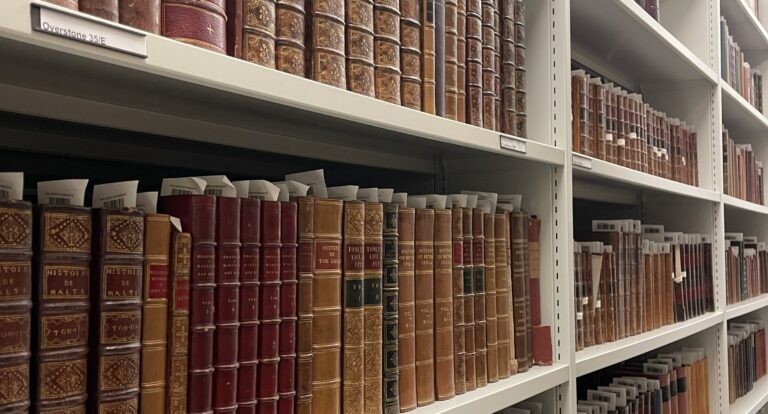
Unknown to many members of the public, Special Collections holds an intriguing assortment of medieval manuscript fragments. They are part of the John and Griselda Lewis Collection, a fascinating collection which consists of some 20,000 items illustrating the history of printing and graphic design from the fourteenth century to the present day. I have had the privilege of working with these manuscript leaves, in an attempt to research, catalogue and raise awareness of their existence.
This project came about through the combination of my personal interest in medieval manuscripts and the need for these fragments to be catalogued for better access. I first became involved with the MERL and Special Collections during my undergraduate degree and this continued into my Masters, for which I just completed my dissertation on French royal medieval manuscripts. The fragments in this collection are all complete leaves/pages which would have made up a medieval book. However, all of the fragments have origins from different books except for two instances.

I have spent the last three months conducting my research upon this variety of medieval manuscript leaves in an attempt to identify the contents of the fragments, date and localise them. The results of this research have shown that the fragments belong to various different books which were produced at different times and places across the medieval period.
Conducting this research is challenging when so little is known regarding the manuscripts, and when they are separated from their original book. However, with each fragment I began with the text. I was able to identify much of the content of the text through conducting transcriptions, followed by online searches of these texts. All but one of these fragments are in Latin, with the other being in Old French and presenting a much greater challenge to the modern reader. Editions of the various texts were therefore located, and have ranged from Thomas Aquinas’ Summa Theologiae to quotations of the Act of Apostles.
Following this identification, an analysis was done of the script. This formed a crucial part of my ability to both date and localise the manuscript fragments. The form of the script indicated the period in which it was written in terms of its style and layout. Gothic textualis was the key script identified across these fragments, although varying in the quality. This was a common book script used from the 12th up to the 16th century. My analysis placed all of the fragments in the 13th and 14th centuries. With a comparison of each the script of each fragment with manuscripts contained in Andrew Watson’s Catalogue of Dated and Datable Manuscripts, I was then able to place these manuscripts within their context. This allowed for a clearer idea of their place of production. All appear to have been produced in continental Europe.

Two of the manuscript fragments in this collection have particularly stood out to me as a result of my research, and I wish to share these with you. First are the two leaves which contain the text of Thomas Aquinas’ Summa Theologiae. I have dated these the late 13th century and into the 14th century, and to have been produced in France. As the text wasn’t completed until 1270, this is a crucial period for the reproduction of this work.

These particular fragments therefore hold particular resonance with me and my current scholarly research. Thomas Aquinas was a leading Dominican theologian in Paris in the 13th century. The influence of the Dominican Order upon the production of manuscripts in Paris in this period was an integral part of my Masters Dissertation. Therefore with such findings came great excitement.
A noteworthy inscription is also contained within the text of the fragment. ‘Thomas Gardener’ is inscribed in between the two columns of the text. This is an indication of the owner of the text, dating to the 16th or 17th century. Although the name Thomas Gardener remains common for the period, it is the greatest provenance in existence across these fragments.
The second prominent fragments were those containing musical notation which have been identified as a Gradual in Latin produced in the 14th century. Graduals are chant books produced for use in mass. In these two fragments we have the Gregorian chants of St Paul and St Anna. It is fascinating to think these would have been actively used during the 14th century for mass.

I hope that through my work with these manuscript fragments further research upon them will be encouraged and conducted. These have been fascinating fragments to work with and I hope others will find them equally intriguing!

-
Published Date
- March 9, 2026
Visualising class, disability, and race on the Victorian stage
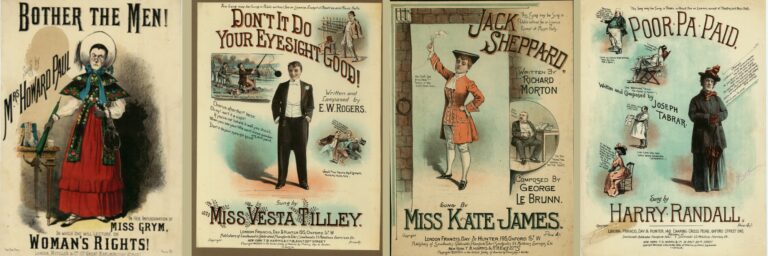
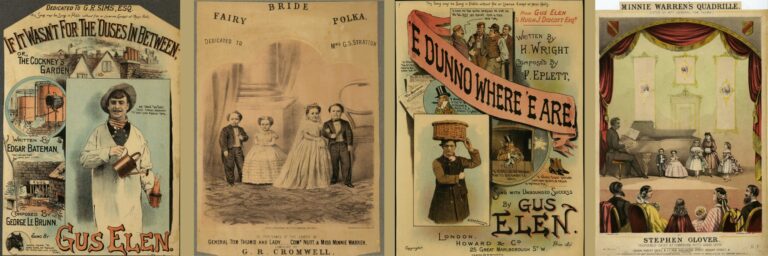
This post introduces, via sheet music covers, a few more real individuals whose stories can be used to explore histories of marginalised people. With only 800 of the covers catalogued so far, there are sure to be countless stories still waiting to be rediscovered.