Visualising class, disability, and race on the Victorian stage
Through the Spellman Collection in the University of Reading's Special Collections
-
Author
- georgiemoore
-
Published Date
- March 9, 2026
Content warning: the Spellman Collection contains offensive language, imagery, and ideology. This blog post discusses racism, blackface and ableism. Learn more about our approach to harmful content.
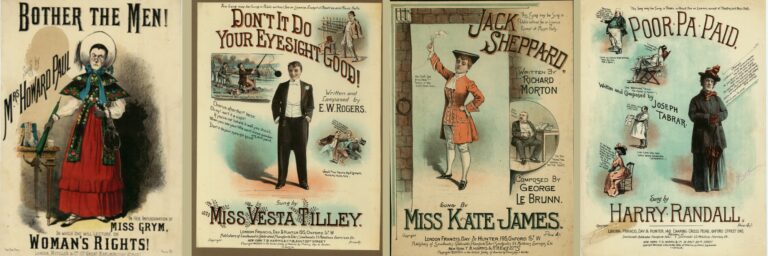
In part 1 of this blog, we introduced the Spellman Collection of Victorian music covers and discussed how the collection could be used to explore gender and sexuality history. This post introduces, via sheet music covers, a few more real individuals whose stories can be used to explore histories of marginalised people. With only 800 of the covers catalogued so far, there are sure to be countless stories still waiting to be rediscovered.
Gus Elen: representing the working class on stage
Class identity was a key concern in the music hall. Outside of the performances themselves, commentators in the 1890s and afterwards worried that an influx of middle-class attendees at the music hall was ruining the authentic, popular music hall culture. On stage, performers continued to represent characters with relatable working-class jobs: from the ‘Mousetrap man’ to shop assistants. Even when popular artists achieved financial success, their ‘relatability’ remained part of their appeal.
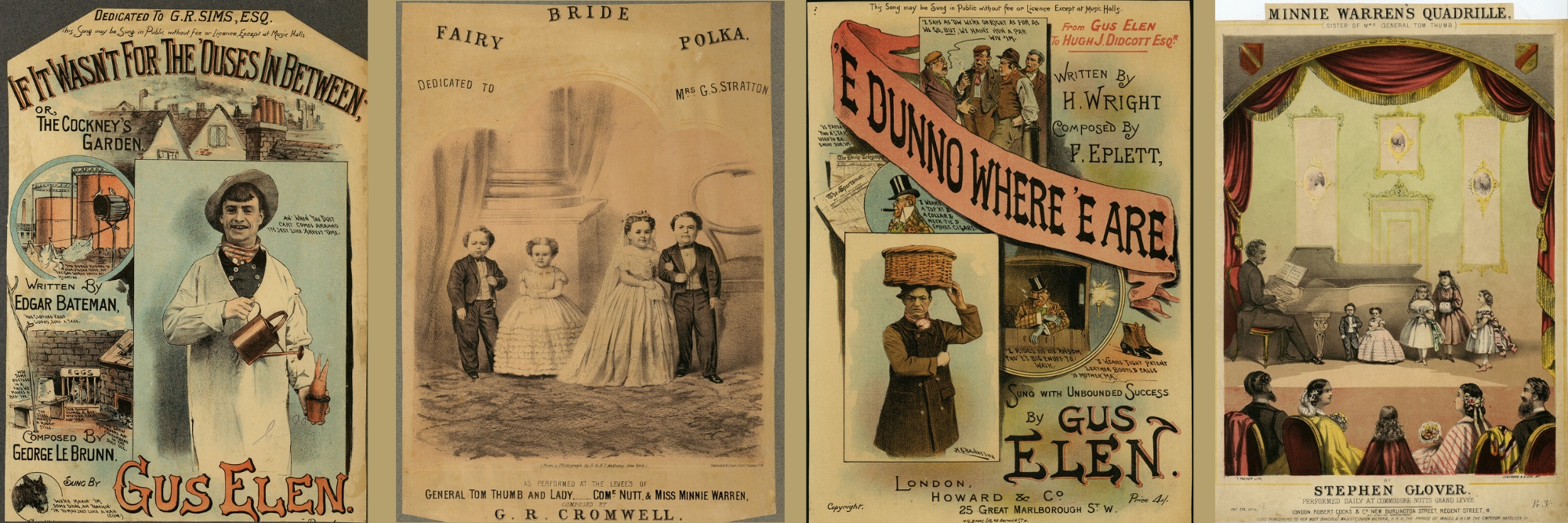
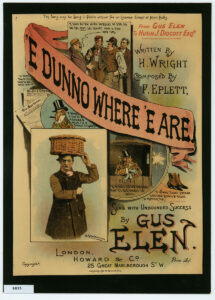
Gus Elen in particular stands out as a distinctly working-class artist – a former barman and packer turned comic singer. Known for his cockney characters, Elen was given the moniker ‘the coster comedian’ (a coster or costermonger is a fruit and vegetable market seller). As well as costume and movement, a key part of his performance was his accent and use of slang, which you can hear in audio recordings of Gus Elen available on YouTube.
The artists designing the sheet music covers represented Elen’s distinct sound by dropping letters from the start of words and using unusual spellings. He is also shown in working clothes and surrounded by cockney scenes. The artists emphasised these distinct characteristics to help market the music and to continually reinforce the story of the artist.
The celebrity wedding of General Tom Thumb and Lavinia Warren
When Lavinia Warren married Charles Stratton on the 10th February 1863, their wedding was New York Times-worthy news. The couple, who both had dwarfism, met while being ‘exhibited’ by showman P. T. Barnum and were well-known in America and England. Stratton, known as General Tom Thumb, had even been greeted ‘with affectionate enthusiasm and enthusiastic affection by the Queen of England’ according to the New York Times. The article, entitled ‘The loving Lilliputians’, emphasised the ‘tremendous furore’ produced by the wedding and the reception hosted by P.T. Barnum, both of which were attended by the ‘crème de la crème’ of New York society.
![portraits of two couples with dwarfism - one a bride and groom. Individuals left to right: Commodore Nutt, [bridesmaid] Minnie Warren; [groom] General Tom Thumb aka Charles Stratton; [bride: Lavinia Warren].](https://collections.reading.ac.uk/special-collections/wp-content/uploads/sites/5/2025/08/Fairy-bride-polka-237x300.jpg)
Was the wedding spectacle just part of the marketing spin for the stars? The couple’s careers were built on their ability to draw a crowd, and there was certainly plenty for the public to talk about. The article reported on the unrequited love groomsman Commodore Nutt felt for Lavinia, and reported on comments made by guests about a potential romance between Nutt and the bride’s sister Minnie. By buying sheet music, perhaps consumers felt they were bringing some of this story’s romance and drama into their home.
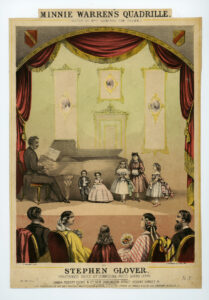
Both music covers shown here were directly informed by photographs produced for the wedding. These photographs were available for the public to buy in the form of cartes de visite (souvenir postcards). The cover for Fairy Bride Polka credits the photographers E and H.T. Anthony for the image of the bridal party. The artist for Minnie Warren’s Quadrille seems to have worked from the same photograph, but they exaggerated the short stature of the couple by depicting them as knee-high relative to the pianist. The fact that photographs were used and credited perhaps lead buyers to think they were seeing accurate images of the celebrities, however it is clear the artist chose to prioritise differences over realism.
Blackface minstrelsy
Blackface minstrelsy performances played on racist stereotypes about enslaved people, often depicting them as lazy and ignorant, while also ‘taking inspiration’ from Black music styles and instruments such as the banjo.
Initially, blackface minstrel troupes performing in Britain were touring performers from America. However, groups were founded in England too, following the same premise and achieving commercial success. The final section of this blog post focusses on two individuals whose stories are found within the Spellman Collection. The music covers mentioned can be accessed via the Virtual Reading Room; here we have included alternative songs written or performed by the Mohawk minstrels, a troupe whose repertoire included Blackface performance.
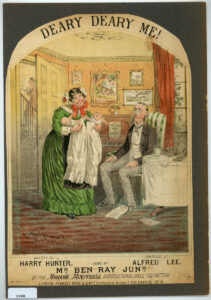
Credited with originating the blackface minstrel character, Thomas D. Rice is the performer depicted on the cover of Sich a gettin’ up stairs. The founding story goes that after watching a disabled African American street performer, Rice was inspired to recreate his act on stage in 1832, and thus set off on a successful career as a blackface performer. The fact that Rice went on to tour in England and America is mentioned on the music cover as part of the marketing.
Another pivotal figure in the history of minstrelsy is James Bland, yet his name and likeness are missing from our 800 digitised covers. Historian Derek Scott describes Bland as the ‘first commercially successful Black songwriter’. He wrote hundreds of minstrel songs, as well as enjoying a multi-decade performing career as a minstrel himself. The most famous song Bland wrote was Carry me back to Old Virginny, but his name is not included on our copy of the cover; instead, the song is advertised as ‘sung by Mr J.H. Cave’ and ‘arranged by Charles Anderson’.
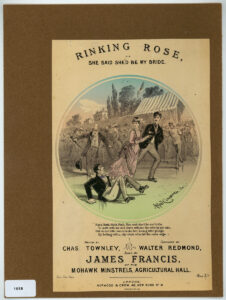
Famous performers took centre stage on the music covers, presumably because their celebrity helped sell copies. This leaves us with a collection where the stories of white performers like Rice and Cave are much easier to spot than those of Black writers like James Bland. It is also worth noting that minstrelsy was widespread, and many music hall performers performed in blackface at some point in their careers. David Taylor notes that it was often a first step in a musical career: Gus Elen performed in blackface, but you would not know this from the Spellman Collection alone, as he became associated with his later cockney character.
Curtain call
The stories told by the music covers were crafted by the artists, performers, publishers and music hall managers. Some we might read as stories of genuine representation, many of exploitation, others maybe as stories of non-conformity or overcoming. For students and researchers interested in race, gender, class, disability in the nineteenth and early twentieth centuries, these blog posts have sought to show that Spellman Collection contains much of interest and hopefully to inspire future research.
Over 800 Spellman Collection covers can be accessed via the Virtual Reading Room.
References
Barry J. Faulk, Music Hall & Modernity : The Late-Victorian Discovery of Popular Culture. (Athens: Ohio University Press, 2004).
Charles Haywood, Bland, James A(llen) in Grove Music Online, (https://doi.org/10.1093/gmo/9781561592630.article.03232, accessed 27 August 2025).
Derek B. Scott, Sounds of the Metropolis: The 19th Century Popular Music Revolution in London, New York, Paris and Vienna (New York: Oxford University Press, 2008).
Derek B. Scott, ‘Blackface Minstrels, Black Minstrels, and their Reception’ in Rachel Cowgill and Julian Rushton, Europe, Empire, and Spectacle in Nineteenth-Century British Music (Abingdon, Oxon ; Taylor and Francis, 2016).
Doreen and Sidney Spellman, Victorian Music Covers, (London: Evelyn, Adams & Mackay, 1969).
David Taylor, ‘Chapter 12: ‘The Minstrels Parade’: Blackface minstrelsy and the music hall’ in From Mummers to Madness: A Social History of Popular Music in England, c.1770s to c.1970s (Huddersfield: University of Huddersfield Press, 2021).
‘THE LOVING LILLIPUTIANS: WARREN-THUMBIANA. Marriage of General Tom Thumb and the Queen of Beauty. Who They Are, What They Have Done, Where They Came from, Where They Are Going. Their Courtship and Wedding Ceremonies, Presents, Crowds of People. THE RECEPTION THE SERENADE.’ in New York Times (1857-1922); (New York, N.Y.: 11 Feb 1863: 8).