Challenging our view of rigid Victorian gender boundaries through music covers
Male and female impersonators and the women's suffrage movement on stage
-
Author
- georgiemoore
-
Published Date
- February 23, 2026
In the first of two blog posts showcasing the research potential of our Spellman Collection of Victorian music covers, we explore gender expression on the Victorian music hall stage.
Content warning: the Spellman Collection contains offensive language, imagery, and ideologies. Learn more about our approach to harmful content.
What is the Spellman Collection?
The University of Reading’s Special Collections hold over 2,500 Victorian sheet music covers, collected by Doreen and Sidney Spellman, a duo interested in these items as examples of colour lithography. Music publishers in the nineteenth and early twentieth century capitalised on improving print technologies and provided high design budgets to drive sales of their sheet music. The resulting cover designs were experimental, eye-catching, and aesthetically pleasing.
While this collection has many research uses, these blog posts will focus on what the Spellman Collection can help us to understand about the representation of marginalised identities in the Victorian music hall, beginning with the representation of gender boundaries.
Who was the music hall for?
Music halls offered exciting variety performances for a wide range of customers. They priced tickets low enough so that working class people could attend, but they also attracted middle-class patrons and even royalty.
Sheet music allowed consumers to take home songs they enjoyed at the music hall. Music hall managers knew that having popular music hall stars on the bill helped sell tickets. Similarly, sheet music publishers knew that featuring these stars in costume on the sheet music covers would help sell copies.
As the cover designs were drawn from photographs, they can help us imagine what music hall attendees saw on stage.
Performing gender in Victorian England
In popular media today, cis-male pantomime dames and drag queens are the most widely represented group of artists who perform as characters of another gender. So, we will begin with an example of the music hall’s female impersonators.
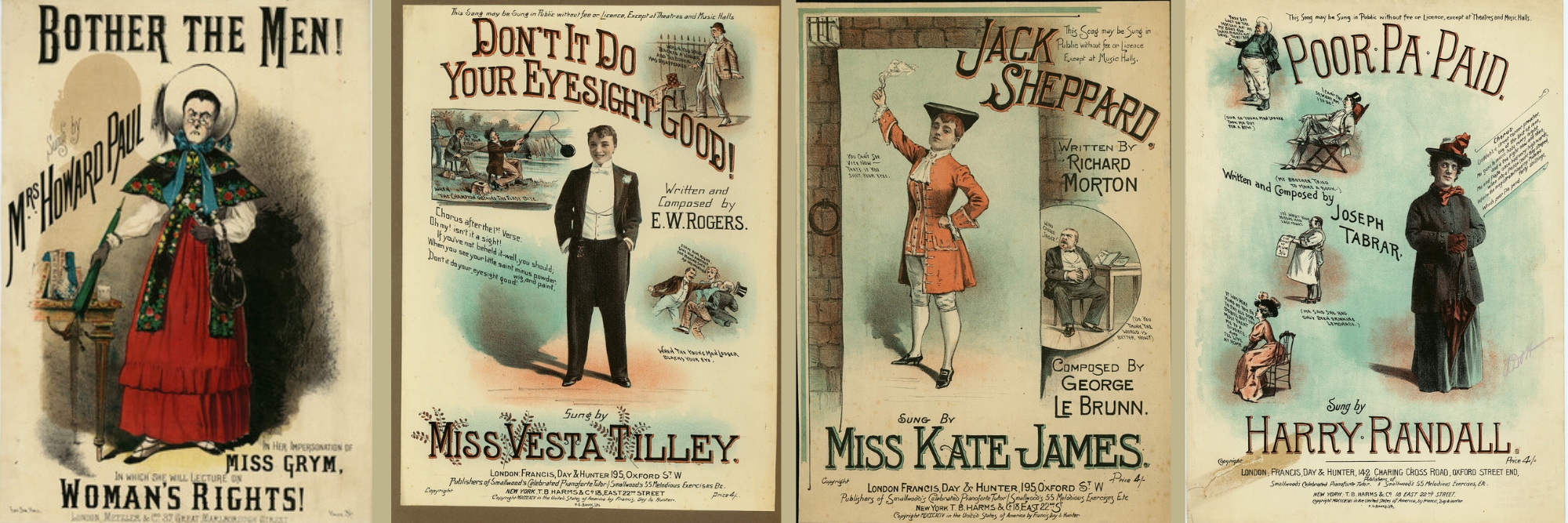
Female impersonator Harry Randall (1857-1932) performed pantomime dame parts as well as music hall numbers as comedic female characters. One example was Randall’s performance of the spendthrift ‘Ma’ in Poor Pa Paid. In this song, ‘Ma’ goes out on the town, runs up tabs and receives fines, which her husband, the ‘poor pa’, is forced to settle her debts the next morning. Randall plays this misogynistic stereotype for laughs.
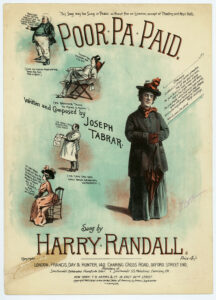
‘Poor pa paid’, published by Francis, Day & Hunter, [1897].
Harry Randall’s female character was mocking women, but that doesn’t mean male impersonators intended to mock men, as our collection shows.
What was male impersonation like?
Male impersonators took on a range of characters, from real historical figures to caricatured dandies. The performances were not simply designed to mock men, and the stars could be popular with male and female audience members.
The historical figure of Jack Sheppard, a renowned thief and two-time prison breaker, appears on multiple music covers, including as a character played by male impersonator Kate James. Sheppard became a much-loved working-class folk hero after his execution in 1724. As his story was continually retold in popular culture, Kate James’s Sheppard could have expected an enthusiastic and sympathetic audience.
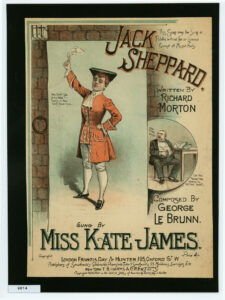
Simon Featherstone describes music halls as a place where performances could be sexualised and flirtatious. In particular, male impersonators pushed the boundaries of acceptable language and movement for women, with flirtatious and masculine movements. They further emphasised these movements by their choice of typical male clothing or ‘burlesque’ attire, similar to an acrobat’s tights. Commenting on one male impersonator’s body language, journalist W.R. Titterton observed: ‘he… poses with crossed legs and staring monocle, … it is a perfect picture…of seaside dandyism’.
![A sumptuous stage setting with three figures in costume (from Little Doctor Faust?), including Miss Warren in 18th century[?] pink men's attire.](https://collections.reading.ac.uk/special-collections/wp-content/uploads/sites/5/2025/08/Lovers-Alphabet-205x300.jpg)
While impersonating male roles, female performers were able to sing about pursuing women. So, is there space for a queer reading of male impersonation?? Gillian Rodger’s research suggests there is: male impersonators were incredibly popular with female audience members, they received devoted fan letters from female fans, and Rodger suggests that at least some had ‘close emotional, and likely also sexual, relationships with women.‘ How far male impersonators challenged the heteronormative gender binary is a matter of debate for historians.
Mainstream success: Vesta Tilley
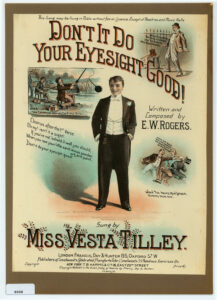
‘Don’t it do your eyesight good!’, published by Francis, Day & Hunter, [1895].
As the most successful male impersonator in Britain, Vesta Tilley received ardent fan letters from men and women, but to quote Kayte Stokoe, she intentionally emphasised the separation ‘between her “proper” feminine, private life, and her onstage persona’. Tilley always wore women’s clothing offstage (unlike some other male impersonators like Annie Hindle). She married Walter de Frece in 1890, and became Lady De Frece when her husband was knighted in 1919.
During the First World War, Tilley was dubbed ‘Britain’s best recruiting sergeant’ as she so effectively promoted army recruitment through her male impersonation act. Without discounting the more conservative elements of Tilley’s life, she is still a part of drag performance history: Worcester-born drag artist Ginny Lemon paid tribute to her in their ‘Queen of your Hometown’ runway look for episode 1 of RuPaul’s Drag Race UK season 2.
‘Votes for women’ and the music hall
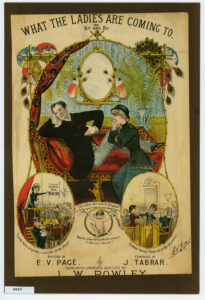
Another aspect of gender history that music covers can help us understand is the feeling towards the women’s suffrage movement. We have two digitised covers that take on the idea of extending the vote to women seem to ridicule the idea. In ‘What the ladies are coming to?’, women propose both marriage and candidates for election. Shown reclining on a chaise longue, the male singer J. H. Rowley seems displeased with the woman asking for his hand in marriage and dismissively turns away from her. More generally, courting, marriage and work were popular themes for music hall songs, so we can also look at the many comedic vignettes on the covers to understand the gendered expectations for men and women’s behaviour in these contexts.
Over a period of several decades, the music hall stage was a place where gender was performed and gender characteristics explored. This post is not an attempt to suggest that gender non-conformity was encouraged, but simply that the nineteenth century attitude to gender was more complex than our popular understanding of Victorian morality might lead us to believe.
In our next blogpost, we will consider how race, class, and disability can be researched through the Spellman Collection.
References
Doreen and Sidney Spellman, Victorian Music Covers, (London: Evelyn, Adams & Mackay, 1969).
Phillip Sugden, ‘John [Jack] Shepphard’, Oxford Dictionary of National Biography, (Online: 01 September 2017).
Simon Featherstone, ‘Vestal Flirtations: The Performance of the Feminine in Late-Nineteenth-Century British Music Hall’, in Nineteenth-century studies 19.1 (2005).
Gillian M. Rodger, Just One of the Boys: Female-To-Male Cross-Dressing on the American Variety Stage, (Illinois: University of Illinois Press, 2018).
Kayte Stokoe, ‘Are Drag Kings Still Too Queer for London? From the Nineteenth-Century Impersonator to the Drag King of Today’ in Sex, time and place : queer histories of London, c.1850 to the present, eds. Simon Avery and Katherine M. Graham, (London: Bloomsbury Academic, 2016).
Derek B. Scott, The Singing Bourgeois: Songs of the Victorian Drawing Room and Parlour, (London: Routledge, 2017).
Deborah Fox, ‘Vesta Tilley & Ginny Lemon: Gender, Fashion & Expression’, Research Worcestershire [accessed 5 August 2025: https://researchworcestershire.wordpress.com/2022/02/04/vesta-tilley-ginny-lemon-gender-fashion-expression/].
-
Published Date
- March 9, 2026
Visualising class, disability, and race on the Victorian stage
This post introduces, via sheet music covers, a few more real individuals whose stories can be used to explore histories of marginalised people. With only 800 of the covers catalogued so far, there are sure to be countless stories still waiting to be rediscovered.