
University Heritage – Whiteknights Park, 1798-1819

A look at the ‘Blandford era’ of Whiteknights Park.
The materials in this online exhibition were compiled by The Friends of the University of Reading as part of their University Heritage leaflet series. For further information about The Friends, including their annual programme of events, list of completed projects and printable copies of the University Heritage leaflets, please visit: thefriends.org.uk
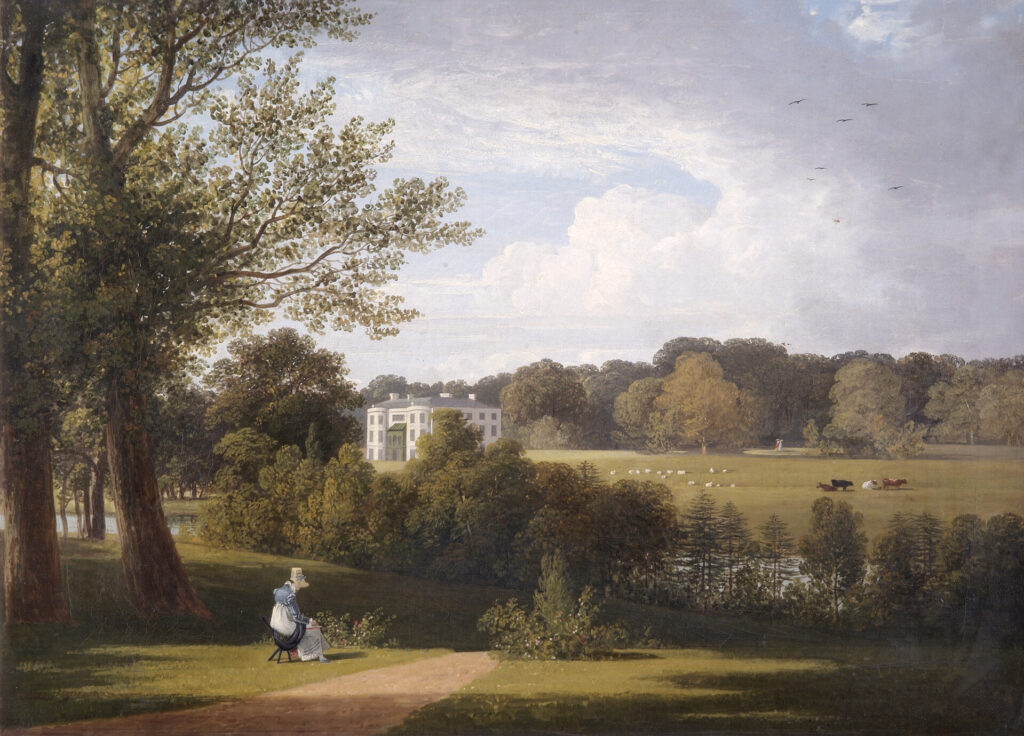
Featured Image: A view of White Knights across the Lake by T. Hofland [UAC/10257]
George Spencer
In 1798 George Spencer, the Marquess of Blandford (later the 5th Duke of Marlborough) and his family moved to Whiteknights Park. Between 1798 and his bankruptcy in 1819, he largely replanned and reordered the park. In addition to the creation of magnificent gardens, the lake was remodeled to its present shape, new paths, treebelts and Pepper Lane were laid out, and hedges removed.
(UAC/10236)
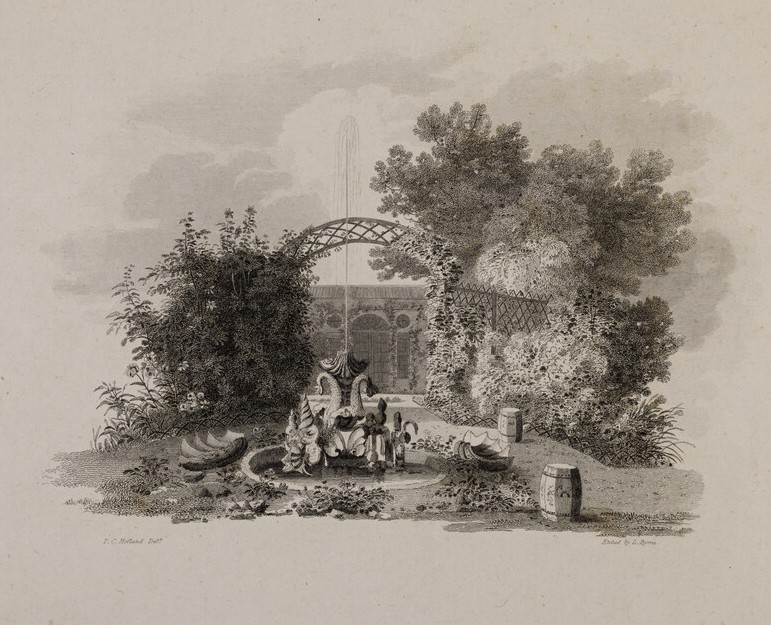
Botanic Gardens
Blandford’s Botanic Gardens were in the area between the present Park House and Whiteknights House. Here was the Linnaean Garden, the Japanese Garden, a Striped Garden with variegated foliage, the Duchess’s Gardens and a formal terrace garden, including the Hexagon Treillage (pictured).
The Gardens also featured a grand avenue of elms, Dial Lawn filled with rare trees and an American Border filled with the latest introductions.
Throughout the gardens were glasshouses filled with tropical plants, such as in the Greenhouse Aquarium, an ‘immense cistern’ filled with water lilies.
(RESERVE MIDDLE FOLIO–914.2291-HOF)
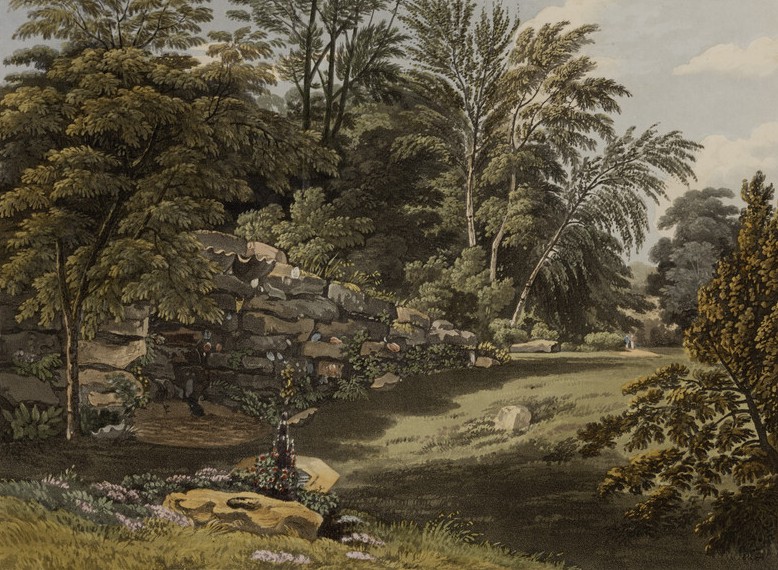
The Woods
The Woods, the area now known as the Wilderness, contained the Laburnum Bower, the Rustic Orchestra, an enclosure ‘large enough to accommodate his Grace’s complete band’, the vineyard, Juniper Lawn, various fountains and the Grotto, a ‘charming retreat, adorned with minerals, shells and ‘sea-weeds’.
The Grotto, constructed of sombre irregular stone, is one of the few features of Blandford’s gardens that still remains. It has Grade II listed status.
(RESERVE MIDDLE FOLIO–914.2291-HOF)
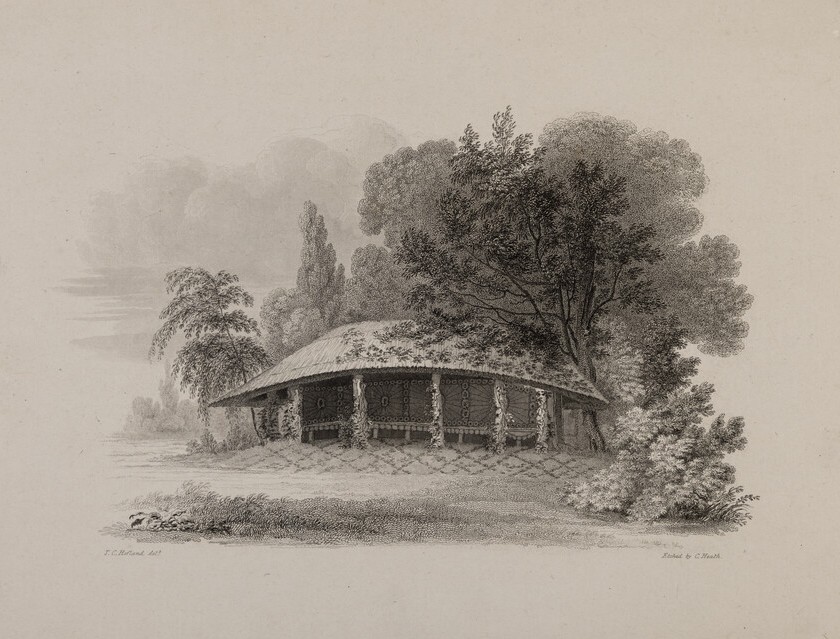
New Gardens
The New Gardens were on the opposite side of the lake from where the main house stood and were approached over a “light, elegant and beautiful” iron bridge. The gardens consisted of a series of walkways that passed through an Elm Grove, a Cedar Grove (red cedar, otherwise Juniperus virginiana), past an American border, ‘thickly planted with the most valuable shrubs and flowers of America’, under a wych-elm grove and on to an oak grove and a Arolla pine walk.
Along the walks were a series of ‘Seats’, some quite small arbour-like structures, others elaborate pavilions. All were constructed in a rustic style from timber and associated materials so none have survived.
(RESERVE MIDDLE FOLIO–914.2291-HOF)
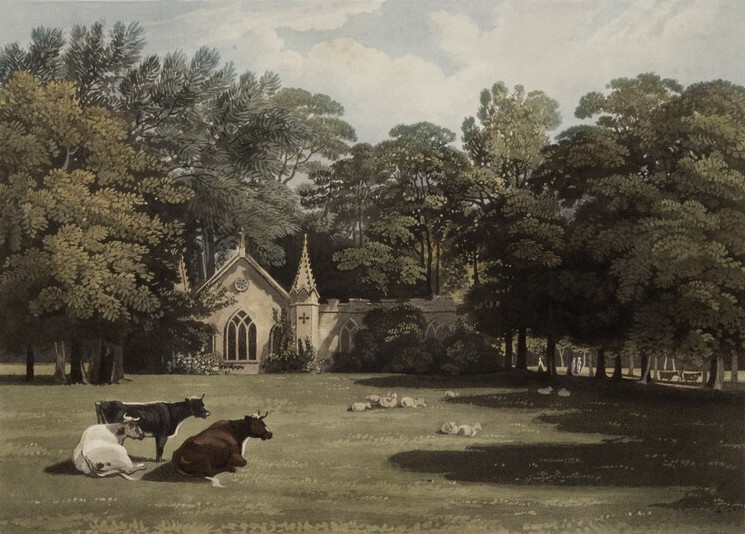
Chapel of St Nicholas
Nothing remains of the Chapel of St Nicholas, the actual location of which has been unclear for many years. Mention of it goes back to 11th century and legend says the White Knight was buried there. What is clear is that the Marquess of Blandford carried out remedial work on what was supposed to be the site of the chapel, and it became known as a ‘folly’.
Thomas Hofland included a colour engraving of the chapel in his wife’s book (pictured). Evidence of the folly survived until the last remains were removed around the turn of the current century.
(RESERVE MIDDLE FOLIO–914.2291-HOF)
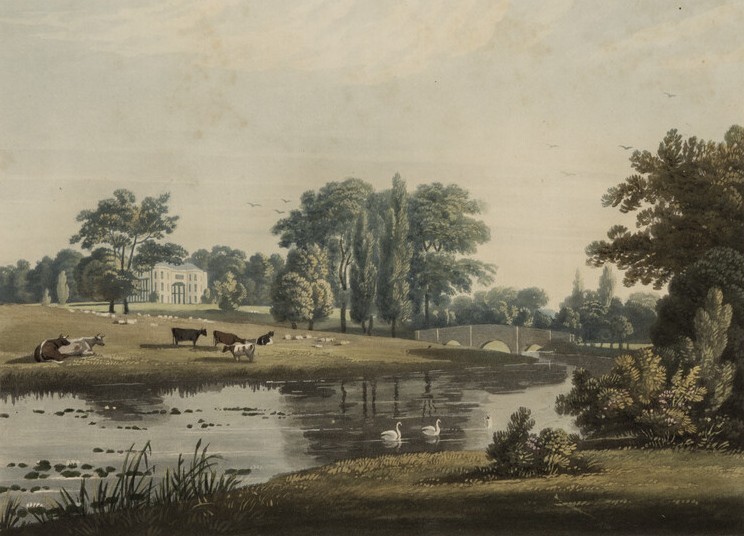
Whiteknights Mansion
The Marquess’s house was decorated in the most fashionable style and filled with fine furniture and paintings by artists such as Rubens, Rembrandt, Holbein and Reynolds. The library housed Blandford’s other obsession, his book collection, including the Bedford Missal of 1442, purchased for £698 in 1786.
By 1819 Blandford was bankrupt, owing over £600,000. There was a public auction lasting 11 days.
(RESERVE MIDDLE FOLIO–914.2291-HOF)
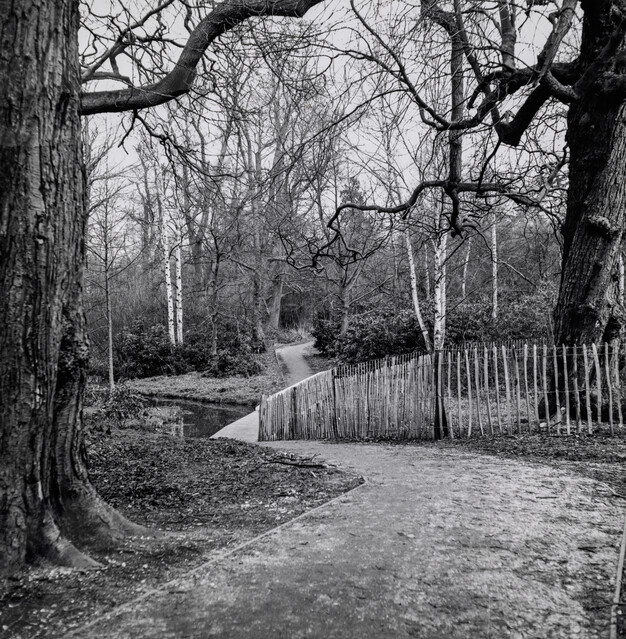
End of the Blandford Era
Blandford’s father died in 1817 and so he now became the 5th Duke of Marlborough and moved to Blenheim in 1819.
The empty mansion was demolished in 1840 and today little of Blandford’s gardens remain although we have a heritage of fine trees some of which probably date from that era.
The more tangible survivals of this landscape are the campus’ modern boundary, its surviving areas of open parkland, the remodeled Wilderness (pictured) including the Grotto, restored in 1985, and the Georgian North and South Lodges at Earley Gate.
(RESERVE MIDDLE FOLIO–914.2291-HOF)