
University Heritage – The Great Hall
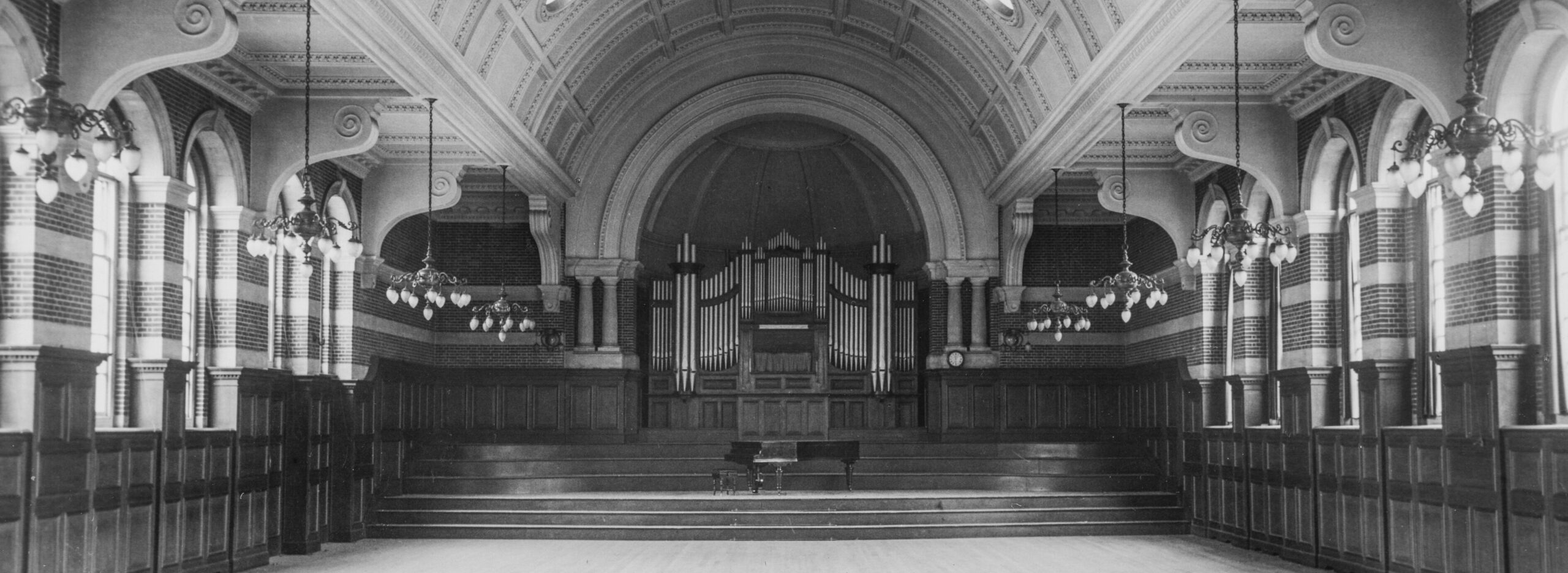
A history of the University of Reading’s Great Hall.
The materials in this online exhibition were compiled by The Friends of the University of Reading as part of their University Heritage leaflet series. For further information about The Friends, including their annual programme of events, list of completed projects and printable copies of the University Heritage leaflets, please visit: thefriends.org.uk
Featured Image: Photograph of the interior of the Great Hall, showing the organ and a piano on stage [UHC PH3/4/1/25]
Origins of the Great Hall
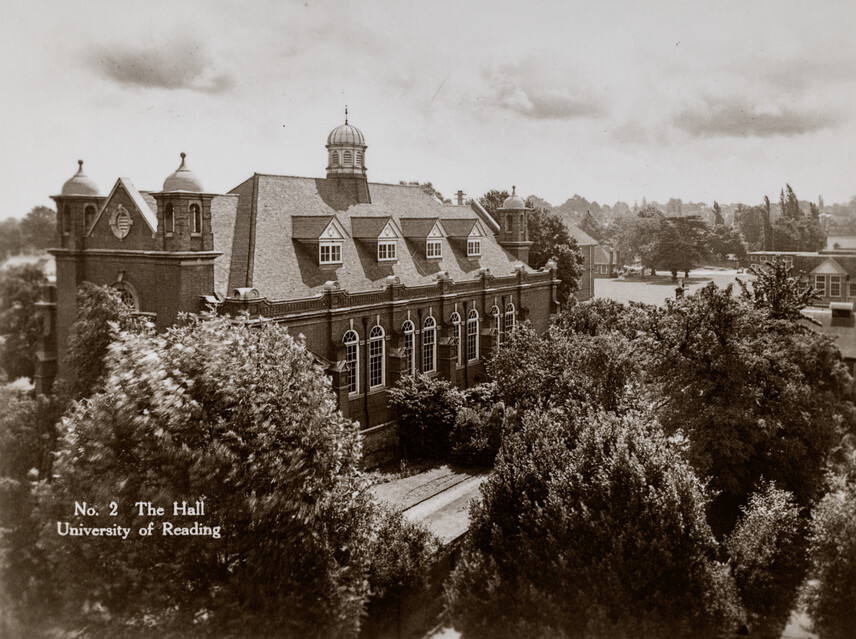
Upon gaining the new London Road site, there was much competition for the limited development funds available. Many staff argued a new assembly hall where all members could meet should be included in development plans from the start, given that an aim of the expanding College was “to be a real society” (as W. M. Childs, the Principal, put it). Alfred Palmer summarised the argument thus: “We must have a heart and home” – and that was the wisdom that prevailed.
The complex of new buildings was designed by local architects W. Ravenscroft and C. S. Smith and funded from reserves and generous contributions from local benefactors. In addition to the assembly hall, a series of seven laboratories and studios was designed for sciences, agriculture, fine art, craft and commerce, each separated by a garden and linked by an open cloister.
(UHC PH3/4/1/32)
Building the Great Hall
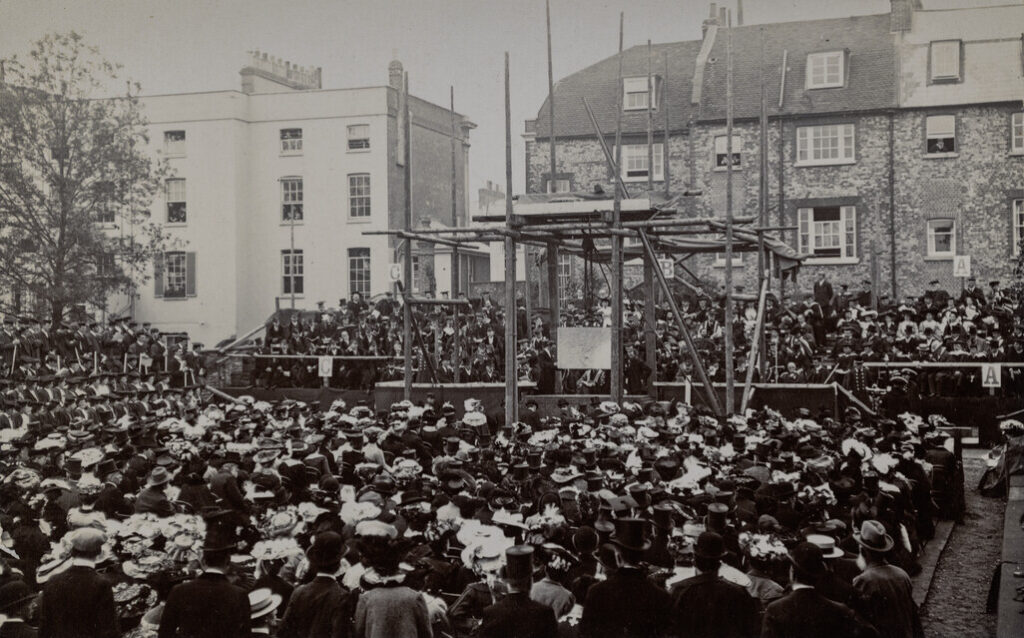
The foundation stone of the hall was laid on 7 June 1905 by Viscount Goschen, Chancellor of the University of Oxford. The event was marked by a grand ceremony that began with luncheon in the Town Hall followed by the transport of guests by ‘electric vehicles’ (trams) to the London Road premises for the stone laying and a garden party.
Little over 18 months elapsed between the laying of the foundation stone on 17 June 1905 and the formal opening of the buildings on 27 October 1906. This was an extraordinarily short time bearing in mind the limited amount of mechanical equipment available at the time.
(UHC PH3/11/5)
The Opening of the Great Hall
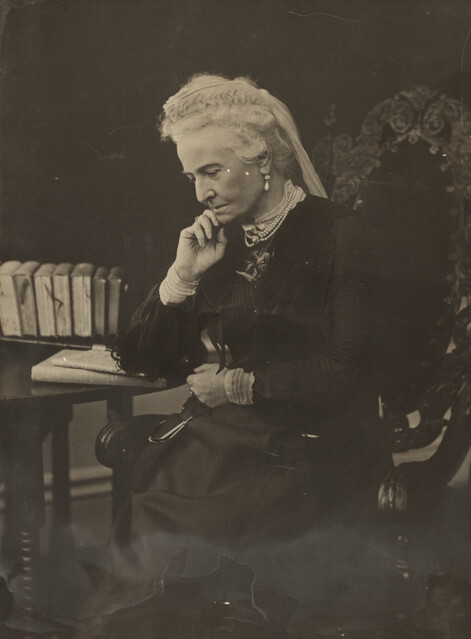
The new buildings were formally opened on 27 October 1906 by Lord Haldane, Secretary for War, who prophesised that, on the basis of progress achieved by the College in the first fourteen years since 1892, it would soon become a university.
Another encouraging announcement made during the ceremony was the gift of funds by Lady Wantage (pictured) for a hall of residence for male students. A notable feature of proceedings was the exclusion of female members of staff and students for fear of interruption by suffragettes.
(UHC PH3/1/86/2)
Social Events
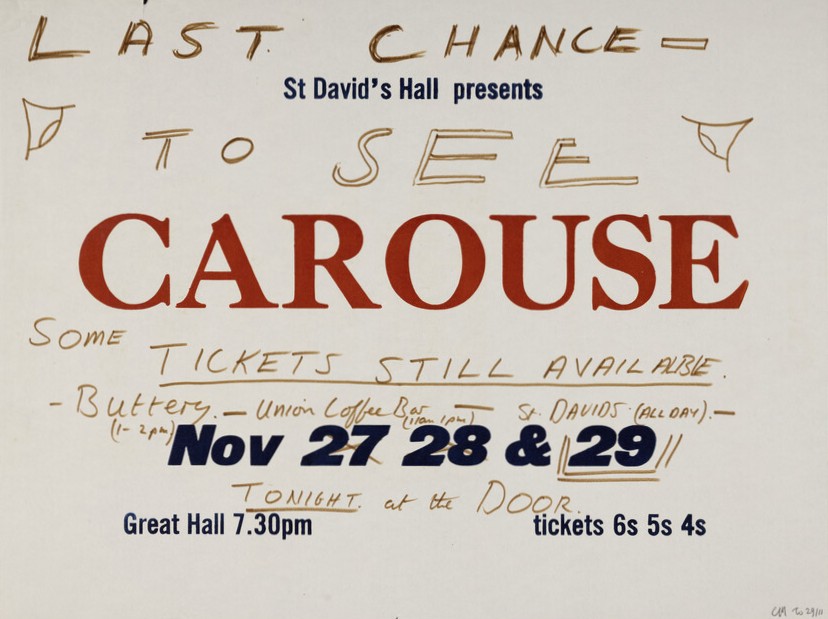
The Great Hall was the main focus for social events until a need for a place for entertainment at London Road declined with the opening of a new Students’ Union building in Whiteknights in 1974. Until then a regular series of dances, including the Vice-Chancellor’s Ball, hops and rock concerts took place. Many famous groups and artists played there including in 1967 an infamous performance by Pink Floyd which was booed by a singularly unappreciative audience! Also Carouse, a revue organised by members of St David’s Hall (a society formed for students in lodgings in 1920 and closed in 2008) was presented there each year.
(UHC CO10/1/346)
Classical Music
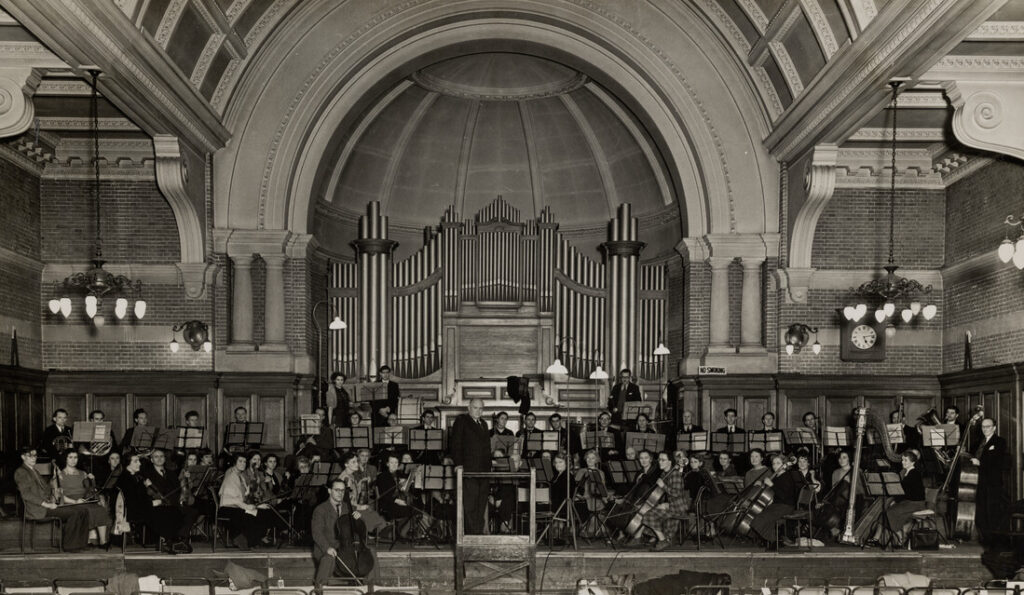
The School of Music moved from Valpy Street to Greenbank on the London Road site in 1904. The directors and conductors included Sir Hugh Allen (later University of Oxford), Sir Adrian Boult (also sometime timpanist), Gustav Holst (note red plaque outside Great Hall) and Thornton Lofthouse (the first person to play the harpsichord in the Albert Hall).
The Foundation Professor Ronald Woodham was appointed in 1951. He conducted the choir and orchestra in a rich range of works including J. S. Bach’s Passions for which leading soloists such as Dame Janet Baker and John Carol Case were engaged. Performances became so popular that some took place in the Town Hall to meet the demand. The degree course ceased in 2003 but music in many forms is still practiced as an extracurricular activity.
(UHC PH3/11/37/7)
Jantaculum
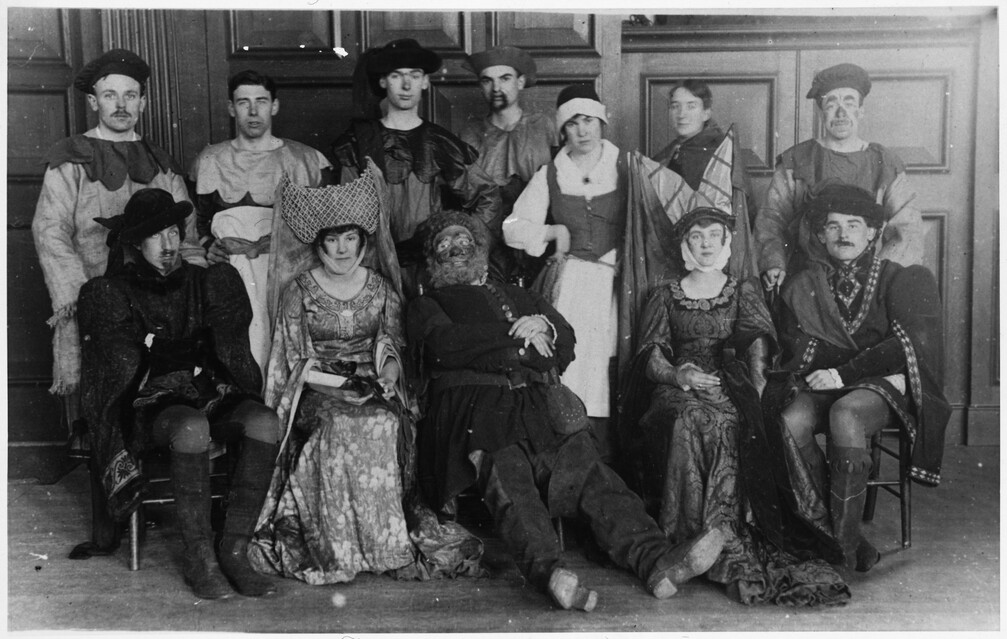
Jantaculum was a popular entertainment held each December presented by the Gild of the Red Rose, a staff/student association founded by Childs in 1897 based on customs and titles associated with ‘The Merchant of Reading’ in the 16th century. Each Gildanus (audience member) wearing a compulsory red rose was individually welcomed by the redcloaked Curia (the organising committee) consisting of Custos, Reeve, Steward, Clerk, Cofferer, Orator, Searcher, Gustator and Forwardmanus. After an entertainment of plays, readings and music, Gildani walked through the cloisters in procession led by the University Singers singing the Boar’s Head carol. On returning to the Hall they received supper accompanied by more carol singing which became increasingly boisterous as the evening wore on.
(UHC PH3/11/37/2)
The Organ
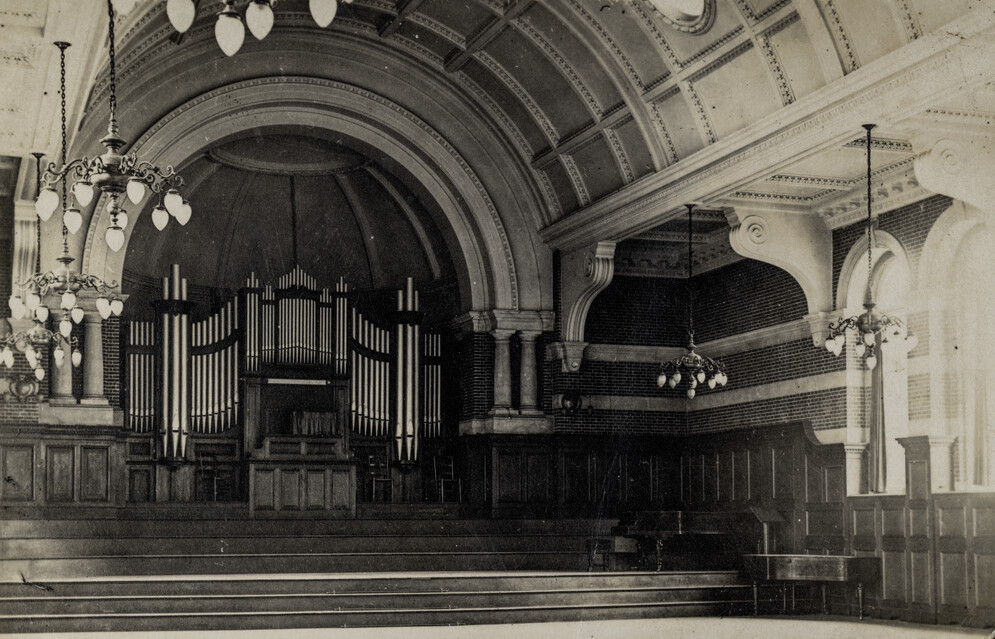
The organ was built by J. J. Binns (Leeds) in 1911 to a specification by Sir Hugh Allen, Director of Music. The purpose was to support voices rather than for playing in a solo capacity though over the years substantial improvements have introduced a more robust character.
In 1926 additional funds were raised to add a Choir division to the original Great, Swell and Pedal provision in appreciation of Childs’ long standing work towards securing the University’s Royal Charter. The bespoke organ case is of cedar wood from a tree that stood on the very place that the organ now occupies. A recital was given in 2011 by Timothy Byram-Wigfield, St George’s Chapel, Windsor to mark its centenary.
(UHC PH3/4/1/22)
Later Alterations
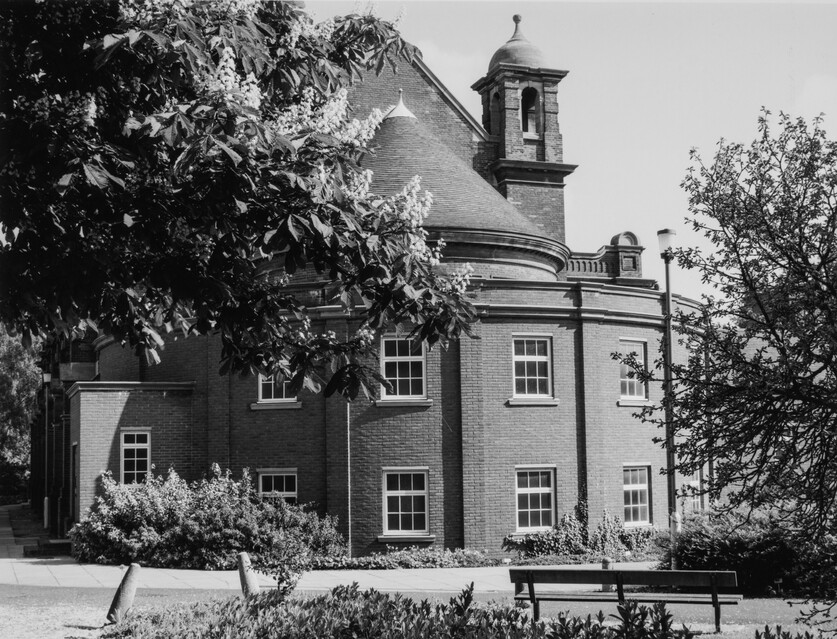
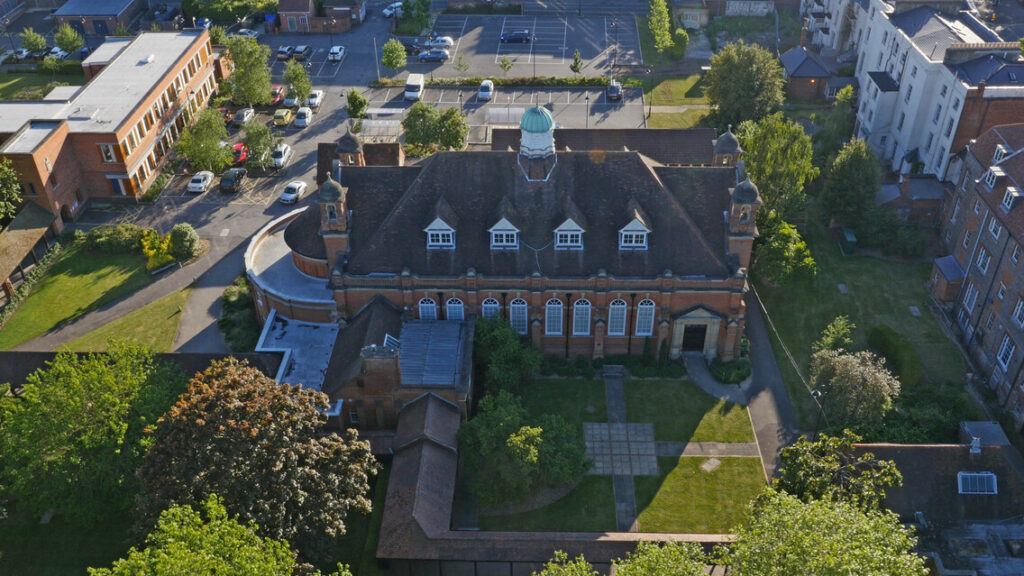
The most significant alteration to the Great Hall, and the one that has had the most impact on its appearance, is the extension to the south organ bay added in 1979. This two storey ancillary building houses ‘back of stage’ facilities for the concert hall. Built in a similar coloured brick and designed to blend in with the original architecture, it provides much needed ancillary accommodation for performers of which the original design had very little.
(UHC PH3/4/1/33)
The Great Hall Today
The hall was refurbished in 1979. It was redecorated, the badly worn oak floor was replaced and an extension added to the outside of the apse. Despite the expectations of the original architects, the acoustics of the hall were less than ideal because of the highly reflective nature of the bare brick, plasterwork and wood panelling. Several attempts at improvement have been made including for many years a separation of the barrel ceiling with a blanket suspended by wires. In 2015 the quality of speech transmission was improved by installing an audio system that digitally directs sound to the audience.
Today the principal uses of the Great Hall are for degree congregations, examinations, concerts and special events (examples elsewhere in this leaflet). The facility is also available for external events such as concerts, school examinations, exhibitions and presentations; recent uses include COVID19 vaccinations and BBC TV’s Any Questions.