
University Heritage – Whiteknights Park 1947-1967

A look at Whiteknights Park during its ‘University Era’, when The University of Reading began building its main campus buildings on the site.
The materials in this online exhibition were compiled by The Friends of the University of Reading as part of their University Heritage leaflet series. For further information about The Friends, including their annual programme of events, list of completed projects and printable copies of the University Heritage leaflets, please visit: thefriends.org.uk
Featured Image: Exterior view of the Faculty of Urban and Regional Studies (FURS) building [UHC PH3/5/4/2]
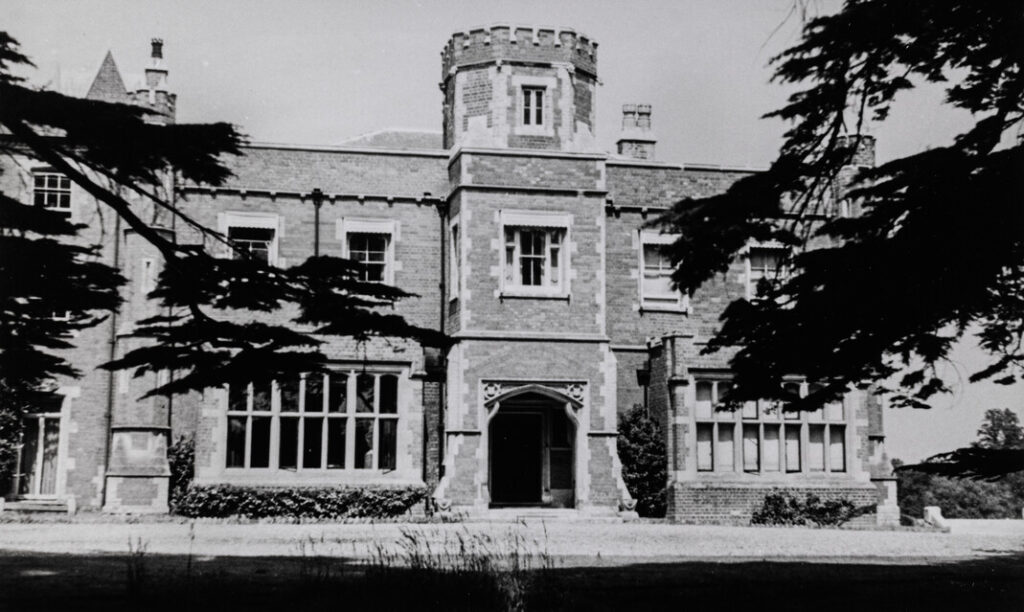
The University of Reading’s Purchase of Whiteknights
By the 1940s, the University was experiencing severe space shortages, its London Road buildings being small and the site restricted. Despite acquiring several nearby buildings (e.g. Hillside), it seemed unlikely that the University would be able to take part in the national expansion scheme for university education which the government intended to promote after the war.
In 1946, seeking to build a new hall of residence, the University purchased Park House situated on a small plot of land on Upper Redlands Road on the edge of Whiteknights Park. During negotiations, it was asked whether the University would be interested in an offer by the Goldsmid family to sell the freehold of the entire estate. The acquisition of a site of some 300 acres would solve the University’s space problems for an almost indefinite period.
(UHC PH3/5/28/5)
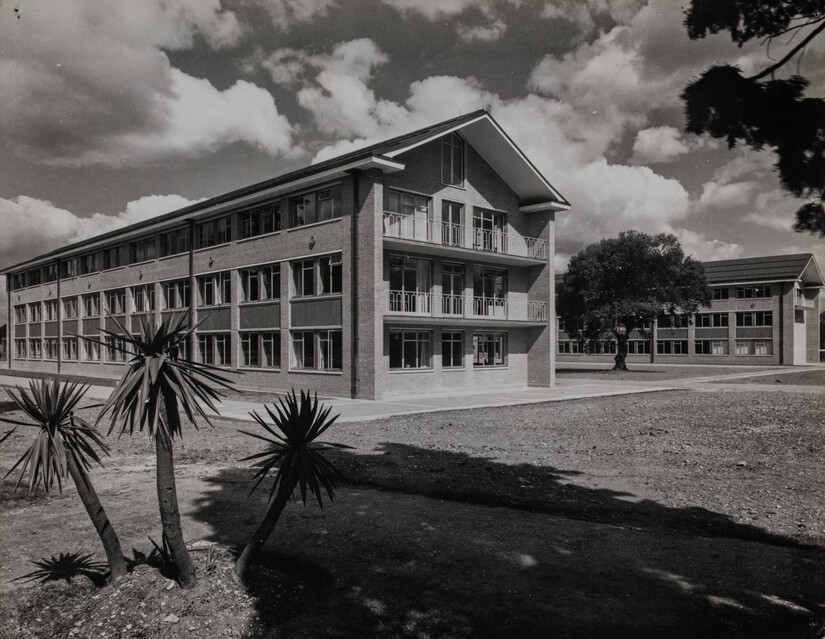
Faculty of Letters
The University acquired Whiteknights Park in 1947, and the next twenty years were crucial to the development of the park and the University.
In the early years the park was used for student accommodation. Thus Whiteknights Park House, Blandford Lodge and Park House became temporary halls of residence.
The first university building to be constructed on Whiteknights was The Faculty of Letters (now known as the Edith Morley building). The Chancellor, Viscount Templewood, laid the foundation stone on 18 May 1955, and the completed building was opened by Her Majesty the Queen on 22 March 1957.
(UHC PH3/5/3/1)
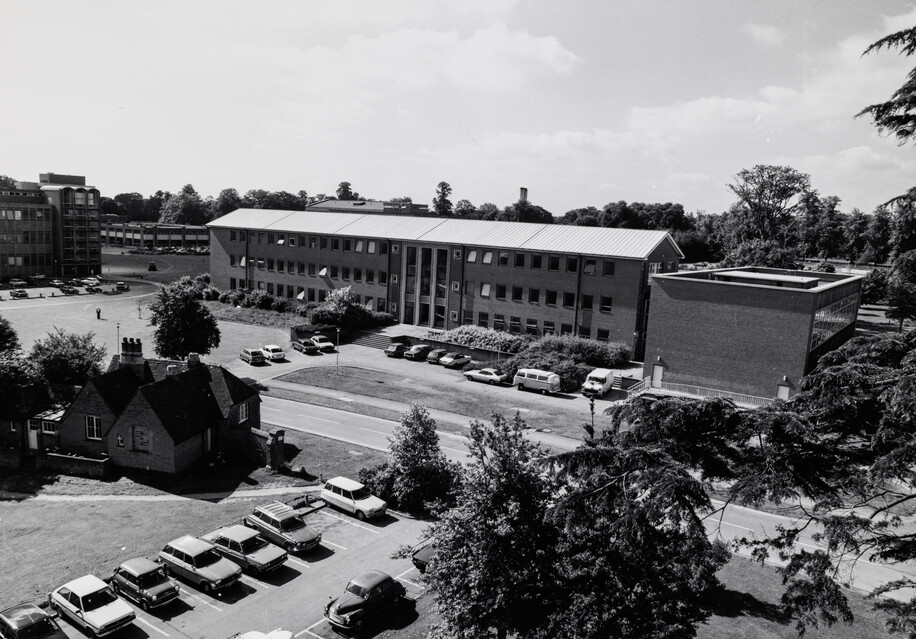
J. J. Thomson Physical Laboratory
The second building to be completed on Whiteknights, the J. J. Thomson Physical Laboratory was named after Sir Joseph John Thomson OM PRS (1856–1940), English physicist and Nobel laureate. It was opened by Sir George Thomson on 17 May 1960. The Mathematics wing was added in 1965–66.
Following the closure of the Department of Physics in 2010 the building is used for a variety of research, teaching and support services. The Physics Laboratory was followed by the construction of Sedimentology Research Laboratory (SRL), Chemistry and Mathematics departments, and the Library.
(UHC PH3/5/6/2)
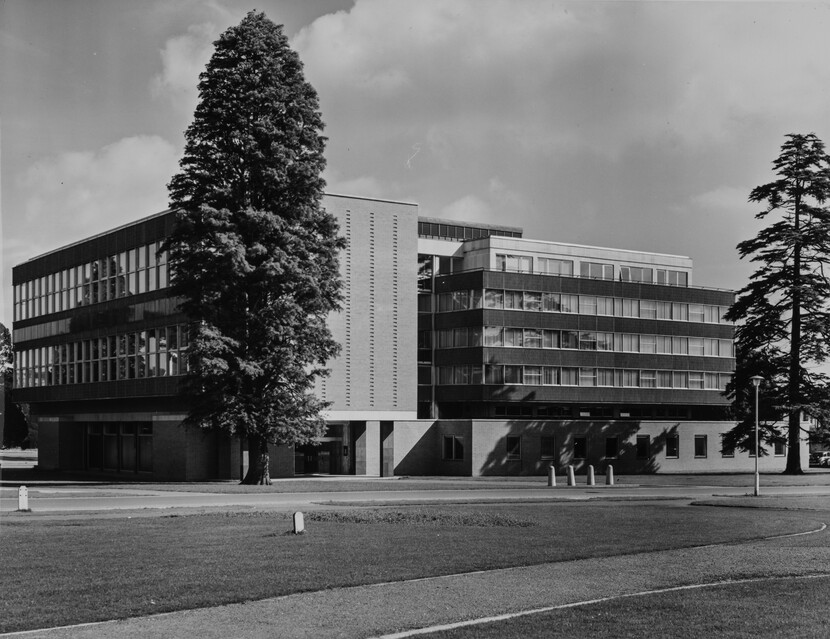
The Library
Planning for the Library was started in 1957, the first sketch designs were made in 1958 and building work started in December 1960. The building was completed in 1963 and officially opened by the Chancellor, the Rt. Hon. Lord Bridges, on 15 May 1964.
The University’s expansion in the 1960s meant the library was soon full and the urgent need for an extension was a preoccupation throughout the 1970s. An extension was completed in 1984. Continuing changes in student needs and demands are reflected in the University having recently undertaken a £40m refurbishment of the building.
(UHC PH3/5/2/3)
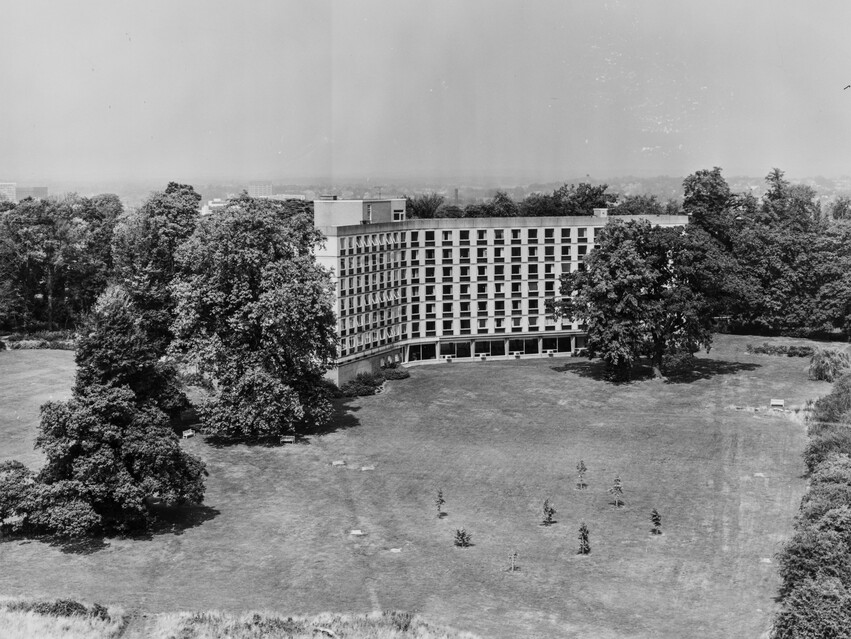
Halls of Residence
In addition to extensions to existing halls of residence, a programme of building new ones began on the 1960s, i.e. Whiteknights (1964), Bridges, Bulmershe, Windsor (pictured) and Wessex (1965), Childs and Sibly (1967).
The building of Wells in 1973 was enabled by the move of the College of Estate Management to Reading. The early 2000s saw the building of five additional residences in Whiteknights and the rebuilding of two existing ones.
(UHC PH3/6/8/2)
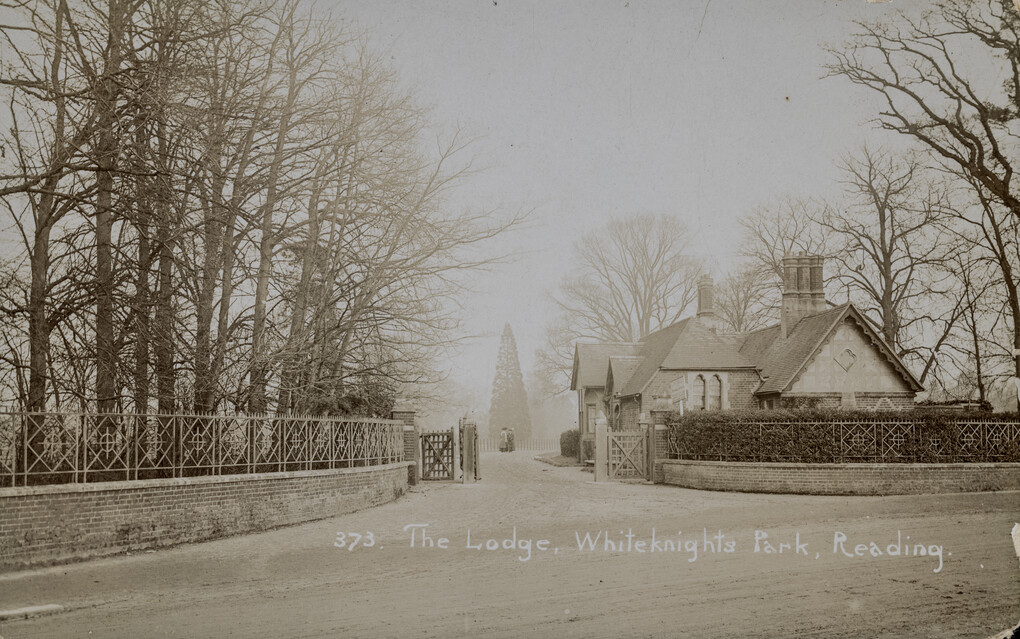
Older Buildings
Elsewhere on campus, the remnants of the earlier occupation slowly died away. As the leases on the Victorian houses expired the University took control of them.
Those which were in a poor state of repair were demolished (i.e. The Wilderness and Erlegh Whiteknights). Four remain, along with most of the Victorian gate lodges, all of which are now Listed Grade II.
(UHC PH3/5/25/6)
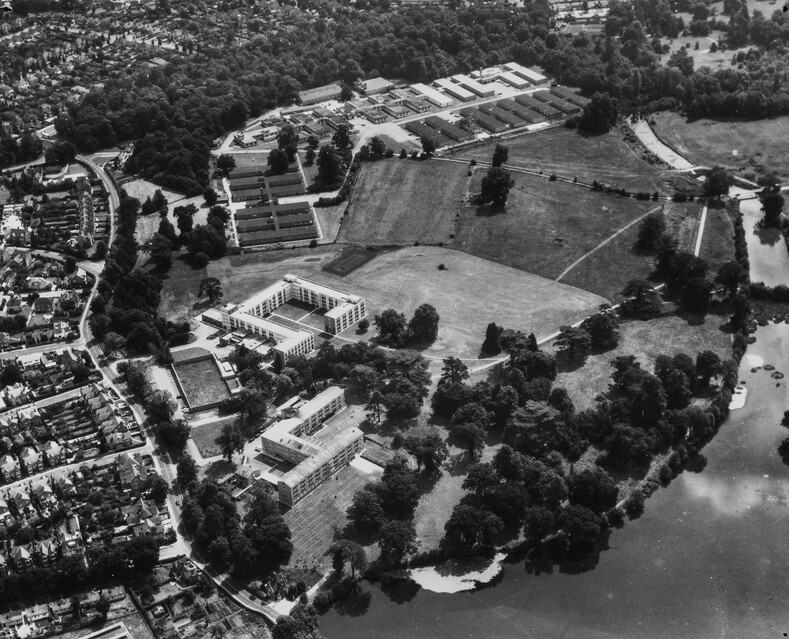
Temporary Office Buildings
At Earley Gate the Temporary Office Buildings (TOBs) remained under government control long after the University purchased the park. Finally, in 1953 the requisitioned area was released to the Ministry of Works for use by many government departments such as Health and Housing. They became part of the University in 1969.
As the University moved up to Whiteknights from London Road the TOBs offered readymade accommodation for departments. Agriculture, Fine Art, Typography, Buildings Maintenance and the University’s Staff Social and Sports Club have all been housed in them. Gradually most of the TOBs have been replaced by modern buildings for Agriculture, Meteorology and Psychology.
(UHC PH3/5/32/5)
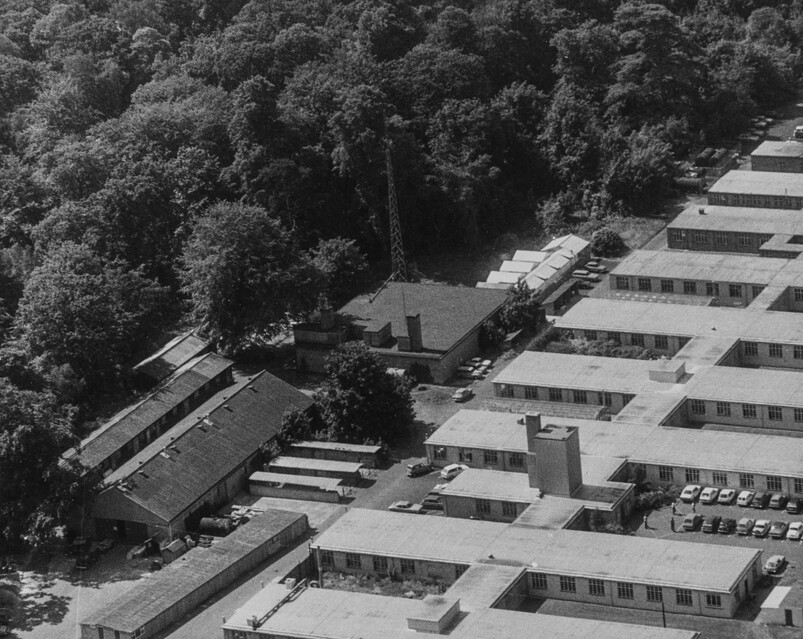
Reading War Room
During the 1950s the government constructed Reading War Room 6, also near Earley Gate.
The Reading War Room was the regional base for Home Defence Region 6 during the early Cold War. It was designed to protect the functions of regional government from the atomic bomb, and to co-ordinate defence. Region 6 broadly covered Dorset, Hampshire and the Isle of Wight, Berkshire, Oxfordshire and Buckinghamshire.
Regional war rooms were replaced in the early 1960s by Regional Seats of Government which were better equipped to cope with the hydrogen bomb. Reading War Room then became the communications centre for the Warren Row Regional Seat of Government, near Henley-on-Thames.
(UHC PH3/5/32/4)