Reading Readers – Jack Davies
-
Author
- micheledrisse
-
Published Date
- January 26, 2016
Jack Davies, Assistant Lecturer of History and PhD student at the University of Kent, tells us about his research into stately home hospitals during the First World War, notably at Cliveden, Buckinghamshire – the home of the Astor family.

My research examines the social and cultural importance of the stately home hospital during the First World War. These personal residences were used to supplement the inadequate military medical infrastructure to provide care for wounded soldiers from all over the British Empire. The University of Reading’s Special Collections have been remarkably useful due to its Nancy Astor archive (MS 1416). The library contains a wide range of correspondence from Nancy herself, who is most famous for being the first female MP to take a seat in the House of Commons in Great Britain.
A lesser-known fact about Nancy Astor, however, was that her and her husband Waldorf converted their home into a hospital during the First World War. After having their initial offer rejected by the War Office, the Astors turned instead to the Canadian government. Though they rejected the use of the home, they agreed to build a hospital on the covered tennis courts; eventually a 600 bed military hospital was created within the house itself.
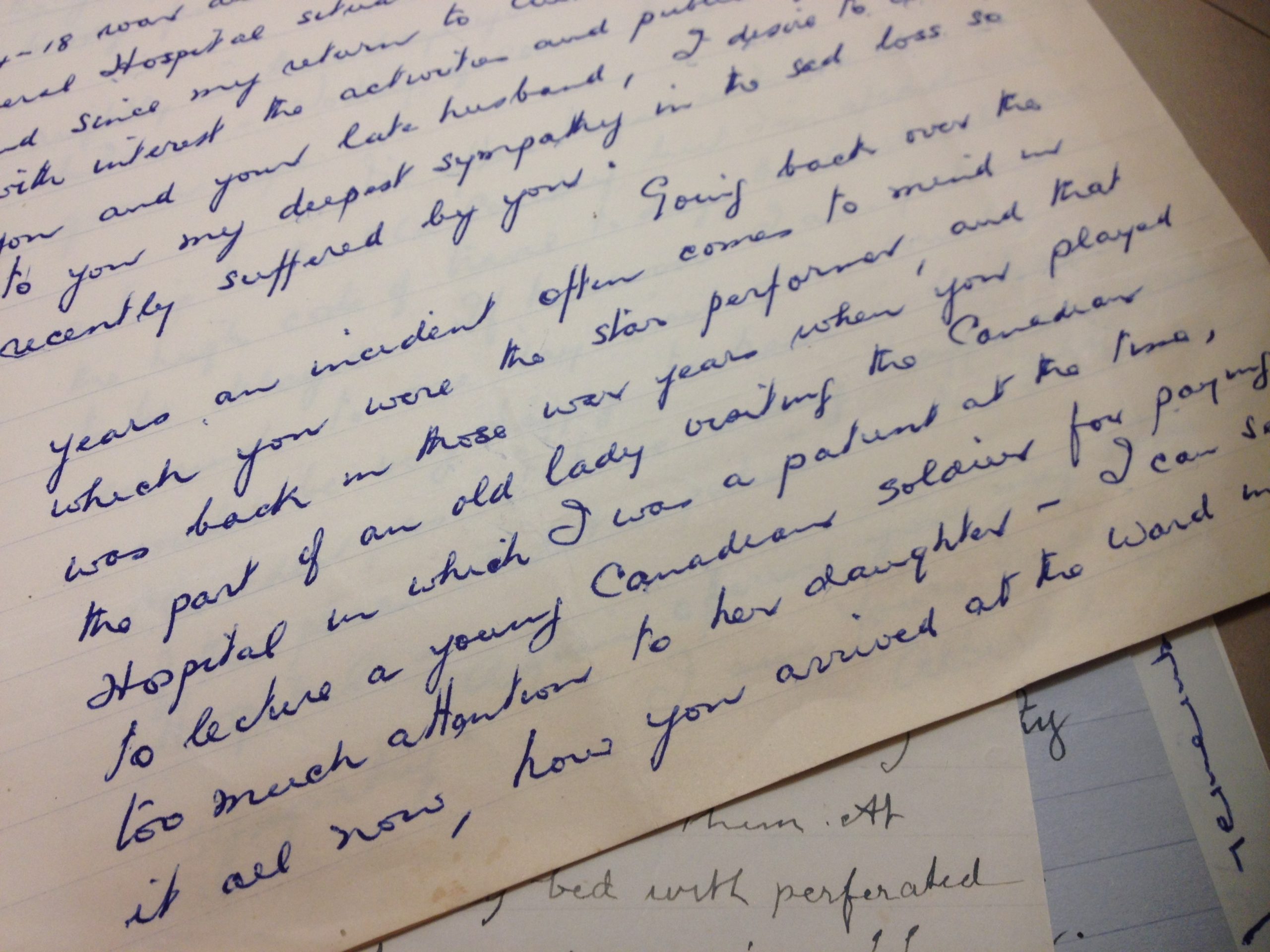
Though perhaps a strange place for me to come to do my research, the Nancy Astor archive contains hundreds of examples of personal correspondence between Lady Astor and the men who recovered within the walls of Cliveden. These letters allow an interesting insight to the use of this building as a hospital. Not only do they enable us to gain an understanding of the events that transpired within the hospital, such as:

‘when you [Nancy Astor] played the part of an old lady visiting the Canadian Hospital in which I was a patient at the time, to lecture a young Canadian soldier for paying too much attention to her daughter’.
They also provide the chance to examine the emotional significance that the hospital space held for wounded Canadians and Australians, many of whom were experiencing Britain for the first time:

‘I often wish I was wandering round your beautiful place again.’
In an attempt to discover the aristocracy’s attitudes towards the transition of their personal space, I also searched through Lady Astor’s correspondence with a number of her relatives, the most interesting of which were those sent by her brother-in-law J.J. Astor. In one, he bizarrely declared:

‘I trust you chose the lingerie with care and great taste, not that it would really matter very much, I expect!”
In another, written after he and fiancée Violet Kynynmound had decided upon a wedding date, he wrote:
‘I am so looking forward to seeing you again, please don’t abuse me for getting married, and you will forgive me for it wont you?’ (ND, MS 1416/1/3/4)
Unfortunately the collection does not contain Nancy’s responses to these peculiar letters, and while we may be unable to discover the truth surrounding their relationship, the discovery of this correspondence certainly piqued my attention, as well as the archivists’ after a long day of research.
Jack Davies is an Assistant Lecturer of History and PhD student at the University of Kent.
You can find out more about the Nancy Astor Archive here, and information about accessing our collections here.
#readingreaders