Oral histories of places, plants and people
In this new blog, Dr Paul Merchant from National Life Stories at The British Library examines what oral history collections can tell us about the relations between places, plants and people (Paul.Merchant@bl.uk)
[Note: The British Library is rebuilding its IT systems following a major cyber-attack. For the latest information on access to the oral history collections, visit blogs.bl.uk/sound-and-vision.]
-
Author
- forestryengland
-
Published Date
- March 10, 2026
The British Library’s oral history collections are a rich resource for scholarship and wider discussion about the relations between places, plants and people. They include extended life story interviews – recorded by National Life Stories (NLS) – with people who have been especially attentive to plants, such as ecologists, farmers and agricultural scientists. The collection continues to grow. Recent interviews, recorded in a partnership between NLS and NERC’s RENEW Biodiversity Programme, explore forms of collaboration in environmental research. (note 1)
In this blog I use audio clips from the collections to briefly explore relations between places, plants and people under three themes: plant utilisation, plants and the environment and vegetal thinking.
Plant utilisation
People continue to use plants – in increasingly sophisticated ways – as natural resources. According to Gibson and Sandilands (2021) this ‘relationship of instrumentality reduces the life of the plant to the uses they provide to particular people in a particular time and place: trees become timber, grain grasses become yield, vegetables become crop’. (note 2)
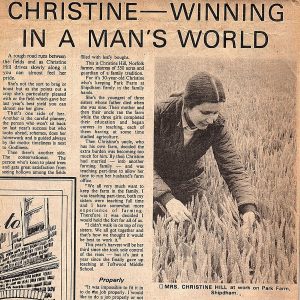
Life story interviews with British farmers, agricultural scientists and advisers suggest that relations with crop plants were not necessarily quite so starkly reduced even as agriculture in the country focused on a remarkably limited range of ‘modern’ approaches after the Second World War (note 3). Growing crops still involved judgements of beauty, close attention to the lives of plants and feelings – for example of duty and love:
I can remember, and I was eleven, so it must have been [after] the time when my father had died that summer, I was actually carting corn. […] And I can even picture where I was on the farm, it was a lovely sunny day and I thought to myself, well crumbs, who’s going to run this farm, who’s going to be able to keep it all together for the family. And I can remember making a conscious decision, thinking, well, I’m going to farm. And I never wavered from it. I’m going to help keep the family together. That was it.
(Christine Hill C1828/16/03. © British Library Board)
Or even shame:
I remember my father – we had a group of farmers came round to our farm – and he felt ashamed about all the wildflowers in his permanent pasture, particularly buttercups. And, now of course, you know, people value those wildflowers tremendously […] but in those days it was very much production-orientated agriculture, nobody thought of the value of plants for biodiversity or anything, not at all.
(Jim Orson C1828/07/22. © British Library Board)
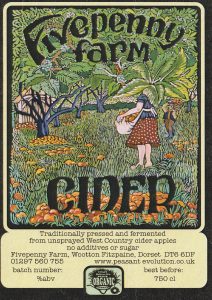
The interviews also capture efforts to resist the colonisation of a few, recommended varieties of crop x or y. Farmer Jyoti Fernandes, for example, speaks of her reliance on the indigenous apple knowledge of West Country farmers who had ‘held onto the old methods’, such as ‘Brian’:
We learned how to thatch from Brian, this old boy that I used to collect the cider apples, from his orchard, from. Well – first of all he taught us about the apples [laughs] you know, first and foremost, because that was the point of connection was going to collect his cider apples. He told us all about the apple varieties that he grew – the traditional varieties – which ones were ready at what time for harvesting, what was useful for different things. […] and also that, you know, that animals can go underneath and how you graze them and stop them getting belly-ache from eating too many rotten apples left on the floor and [laugh] that kind of thing.
(Jyoti Fernandes C1828/41/10. © British Library Board)
And David Mwanaka tells us about his efforts to grow white maize in gardens and fields in and around London, beginning with this ill-fated episode:
I come from Zimbabwe […] and when I came to the UK there was no white maize in the country so after a while I thought let me, let me try, let me do some trials of growing white maize in my back garden. And the first year I did try I was living in Tottenham […] in a two-storey building; I was in the top floor, my wife and I, and downstairs there was a lady – the ground floor there was a lady who lived there who actually had a garden. So I gave her some seed of white maize and asked if she was prepared to grow the white maize for me […] I just wanted to see if they could grow to maturity. She did agree but unfortunately the lady passed away just before the maize actually matured so, because she only had access to the garden, I couldn’t go there to check how may maize was doing.
(David Mwanaka C1828/24/02. © British Library Board)
Plants and the environment
The oral histories allow us to follow ways in which concern with ‘the environment’ has brought people into particular relations with plants and places. I sketch three of these relations here.
i. nature conservation
Loss of bogs, woods and grassland to ‘development’ of all kinds (including agriculture) focused the attention of ecologists, naturalists and others on what was left. Among many other accounts in the collections, botanist Nigel Bell describes his autoecological studies of bog plant Empetrum nigrum (crowberry) on Wybunbury Moss National Nature Reserve in the 1960s:
I tried to find out about […] what its physiological requirements were […] I remember a friend of mine […] being highly amused that we spent a Saturday morning on the top of Snake Pass collecting grouse shit so that I could pick out the seeds, to see if passage through the grouse’s gut helped to make the seeds germinate. It didn’t.
(Nigel Bell C1379-91 Track 3)
Historical geographer John Sheail recalls research in the Grassland Section of the Nature Conservancy’s Monks Wood Experimental Station in the 1970s and 80s in the context of alarm about loss of ‘biological richness’:
Oh there was despair that the grasslands were becoming, even where they survived, so impoverished of species through not only the way in which animals were grazed but the introduction of herbicides, and that. They were grasslands, but they had very little biological interest as a result of what farmers were doing. So the challenge was to bring out just what was being lost in terms of not only the species richness botanically but also insect-wise, even mammal-wise. It was a period of colossal change.
(John Sheail, Track 2, Oral Histories of Environmental Collaboration. © University of Exeter)
Meanwhile Sue Clifford, with Angela King, was encouraging people of all kinds – not just ecologists – to attend to and value local flora through the campaigns of Common Ground:
Interviewer: Someone was suggesting that your attempts to generate interest in the local tree was a step to being interested in, say, rainforests?
Sue Clifford: I mean, yes fine if that’s the sort of mind you have. But out task, the task we gave ourselves was to do it here. And constantly being lured into equatorial forests or whatever wasn’t the name of the game. I mean we would never had said don’t look after the rainforests; on the contrary lots of our friends were out there fighting for the peoples and the trees and the creatures and, you know, I went to UNEP gatherings in Kenya and things like that. You focus on what you think you can achieve and what we wanted to do was to get people to doing it here. […] When it’s right here, and it affects you and you know that in another place in the south of Italy or somewhere else someone is doing the same thing to try and save olive trees or an orchard or a something because its livelihood and its ecology then you, you connect.
(Sue Clifford, Track 4, Oral Histories of Environmental Collaboration. © University of Exeter)
ii. indicator plants
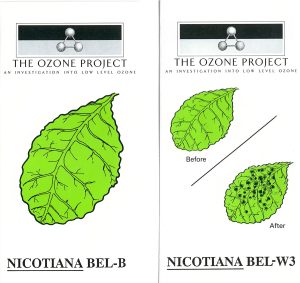
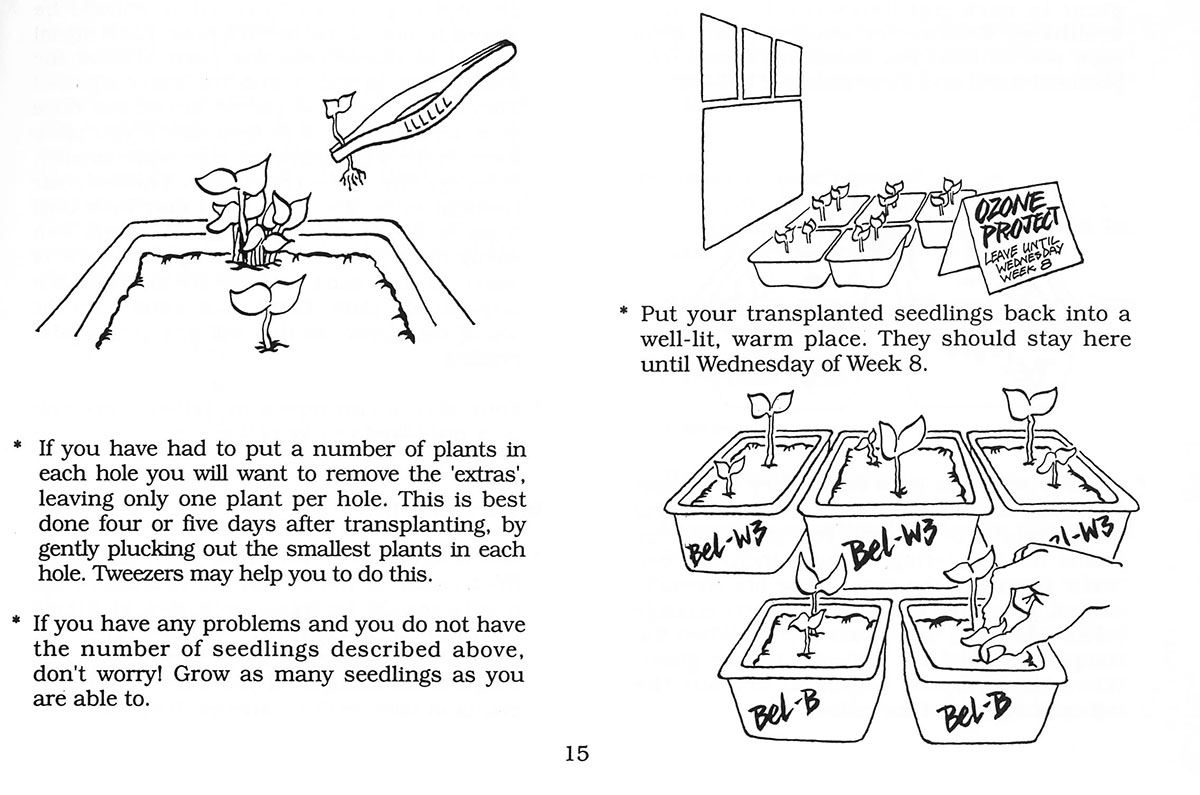
Plants have been used as indicators of pollution in professional and ‘citizen’ science. Several interviews feature the use of the tobacco plant to register ozone pollution. Here, Mary Hollingsworth recalls the ‘ozone project’ of the Wildlife Trusts junior section, WATCH, in which participants were expected to grow their indicator plants from seed:
The idea was […] that you could get a packet of nicotiana seeds and plant them, grow the plants and then there would be a card showing you the spotted leaves at different levels and that would be linked to a measure of the ozone in the area. You would send that information back to the central point and an ozone pattern for the UK would emerge. […] The hitch was – it’s really, really hard to get these flippin’ seeds to germinate [laughs]. So for year two the project officer […] found a grower that would actually grow the seeds to sort of large seeding stage so […] people could send away for a batch of seedlings and then they were sent to the schools or the groups or whatever.
(Mary Hollingsworth, Track 1, Oral Histories of Environmental Collaboration. © University of Exeter)
iii. community planting
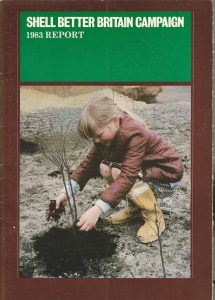
Efforts to involve local communities in environmental projects have almost always involved planting, whether trees, wildflowers, grasses or vegetables. One example – explored in Diane Warburton’s life story interview – is the Shell Better Britain Campaign in the1980s and early 1990s:
It was mostly about improving land and buildings because it was – we were thinking about people’s living environments and improving where people were living. […] The focus of Shell Better Britain was on practical projects – really practical sort of back-yardy type projects. Neighbourhood projects, which could have global implications but it was, it was, it tended to focus on the quality of life and, you know, local wildlife and local greening rather than planetary issues.
(Diane Warburton, Track 6, Oral Histories of Environmental Collaboration. © Diane Warburton)
Vegetable growing has also been central to successful efforts by the Black Environment Network (BEN), since the 1980s, to broaden the scope of ‘environmental’ action in Britain:
At that time the assumption was that the environmental movement was fine as it was. It was purely white; one hundred percent white. And so we brought in the idea that with funding you need to have a much wider range of what an environmental project is. That is very innovative as well in terms of how we saw things in the beginning. Because it was something that the environmental sector laughed at – because when we asked minorities what they wanted, they wanted things like: grow vegetables, they wanted to have a community garden and so on. And the laughed; they said, ‘well this is not wildlife’, you know. […] We proposed that you can teach any environmental principle about a living thing from any plant no matter how modified. Including horticulture and food growing. You can teach all the principles from a food plant. Or from a garden plant. So why do you just bang on about wildness, which is more remote?
(Judy Ling Wong, Track 1, Oral Histories of Environmental Collaboration. © University of Exeter)
Vegetal thinking
We live in a world in which seven of nine ‘planetary boundaries’ have been breached. Twenty per cent of the world’s plant species are threatened with extinction (note 4). In the UK biodiversity has been in decline since the 1970s. And this is only to list some of the physical-ecological problems! No wonder that scholars and commentators of all kinds are seeking to question dominant structures and habits of thought – fixed into institutions and organisations and processes of all kinds – that have propped up an apparently failing order of things.
For many, plants point us towards new ways of understanding what reality consists of, highlighting processes of ‘becoming’ (rather a concern with fixed ‘identities’), the power of dispersed ‘non-representational thinking’ and the role of complex ‘assemblages’ of different species and things (note 5). This plant inspired ontology draws our attention to human rootedness and dependence:
The process of thinking like a plant reveals to us what we have chosen to forget in dominant Western philosophical and scientific imaginations of our human selves as primarily rational, self-organizing, and independent beings over and above all others: a sense of our profound dependence on and location in the conditions of growth and decay, including the other beings with whom we share these elements of liveliness .
(note 6)
If human life is inescapably part of complex ‘assemblages’ of living and non-living things, then it follows that – in order to understand our present environmental predicament – we need research that is ambitiously interdisciplinary, mixing natural science, social science, the humanities and arts. Ongoing interviews capture past and present attempts to work across the boundaries of academic disciplines and professional sectors (such as nature conservation and agriculture). Environmental scientist Tim O’Riordan feels that we are getting there – but a certain ‘stickiness’ remains:
There’s absolutely no way we need to be any longer so pussy-footing and so still sticking in the mud about disciplinarily. […] We must have no fear and no inhibition for interdisciplinarity and we haven’t got that yet. We’re getting there. We’ve gone through the most remarkable transformation of what we’ll call knowledge and understanding and certainly in how we integrate concepts of knowledge and research and action, but it’s not enough, it’s nothing like enough, and we’re being too slow in the process, and we’re still sticky. So the question is: can we in a relatively short period of time – let’s say 25 years to 2050 – really get to grips this or will we be in – when we’re still getting to 2050, still struggling with something which is a half hearted, half cooked version of what we’re heading for?
(Tim O’Riordan, Track 2, Oral Histories of Environmental Collaboration. © University of Exeter)
Perhaps further interdisciplinary thinking about places, plants and people can help us feel the way forward.
Dr Paul Merchant, National Life Stories, The British Library (Paul.Merchant@bl.uk)
Notes:
- This work was supported by the Natural Environment Research Council funded Changing the Environment programme’s project ‘Renewing biodiversity through a people-in-nature approach (RENEW)’ (NE/W004941/1) and University of Exeter Translational Funding (AHRC IAA).
- Prudence Gibson and Catriona Sandilands 2021 Introduction Plant Performance Performance Philosophy 6(2) 10
- Paul Merchant 2024 Life stories of agricultural-environmental change Oral History 52, 3 112-122
- Gibson and Sandilands 2021, 13
- Hannah Stark 2015 ‘Deleuze and Critical Plant Studies’ in in Jon Roffe and Hannah Stark (eds.) Deleuze and the Non/Human London: Palgrave Macmillan 180-196; Catriona Sandilands 2021 ‘Plants’ in Jeffrey Cohen and Stephanie Foote (eds.) The Cambridge Companion to Environmental Humanities Cambridge University Press 156-169; Catriona Sandilands 2017 ‘Vegetate’ in Jeffrey Cohen and Lowell Duckert (eds.) Veer Ecology: A Companion for Environmental Thinking University of Minnesota Press 16-29
- Sandilands 2017, 19
Image credits:
Page from ‘The Ozone Project’ information pack, 1990. Courtesy of Mary Hollingsworth
Clipping from Eastern Daily Press, 13 July 1982. Courtesy of Christine Hill
Fivepenny Farm cider bottle label. Courtesy of Jyoti Fernandes
Packets of nicotiana seeds for ‘The Ozone Project’, 1990. Courtesy of Mary Hollingsworth
Cover of Shell Better Britain Campaign Report, 1983. Courtesy of Diane Warburton